Eco Pack Friend Editorial Team
Understanding corrugated flute types: what the letters reveal about box construction
Corrugated flute letters describe profile geometry and combinations, but leave paper specifications, finished-box strength and humid-storage performance unresolved. This guide explains dimensions, wall construction and test distinctions, then applies them to a Malaysian e-commerce storeroom and a practical supplier checklist.
A quotation saying "BC double wall" leaves a Malaysian online seller with a practical question: will these cartons hold up while packed orders wait for courier collection? For small-business owners and fulfilment teams, understanding corrugated flute types helps you read the construction, spot missing specifications and ask for useful performance evidence.
Key takeaway: flute letters describe corrugated profiles; combinations identify profiles used together. They do not establish the component papers, finished-box strength or suitability for humid storage. Read the geometry first, then specify the complete box and the conditions it must withstand.
What the designation tells you
Separate the information into three levels:
- Stated construction: the profile family and, for combinations such as BC, the profiles used together.
- Suggested tendencies: differences in thickness, cushioning behaviour, liner support and folding requirements.
- Unproven performance: load capacity, protection of a particular product and behaviour after storage.
As Summa Support’s F Series: Packaging Info explains, corrugated flute designations describe profile geometry, mechanical grades describe mechanical requirements, and FEFCO box-style codes describe box shape.
A flute letter describes a structure, not a safe load.
Read the wave: height, pitch and count
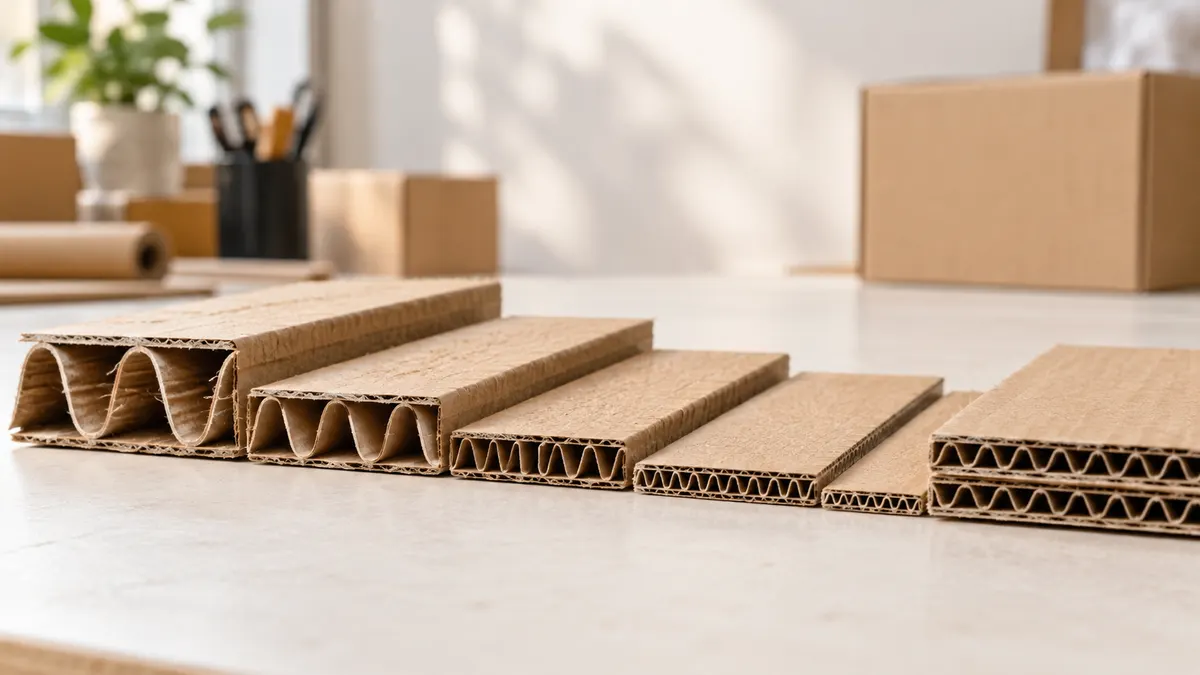
To understand corrugated flute height and pitch, look at a cut edge across the waves. Height runs vertically from trough level to crest level. Pitch is the horizontal distance between adjacent crests.
          crest           crest
            ↓               ↓
            /\              /\      ↑
           /  \            /  \     │ height
__________/    \__________/    \____↓ trough level
            ←──── pitch ────→
Flute count measures repeated waves per metre across the corrugations. Closer spacing means more waves within that distance. Letters identify families: Summa lists B-flute height as 2.2 to 3.0 mm and pitch as 5.5 to 6.5 mm. These reference ranges do not replace an agreed supplier specification. Source: Summa’s flute-dimension table.
| Profile | Flute height | Flutes per metre |
|---|---|---|
| A | 4.8 mm | 110 |
| C | 3.6 mm | 130 |
| B | 2.4 mm | 150 |
| E | 1.2 mm | 290 |
| F/G/N, grouped in the reference | 0.5 to 0.8 mm | 400 to 550 |
The height sequence is A, C, B, E, not alphabetical. Figures come from Table 2 of FEFCO and Cepi ContainerBoard’s European Database for Corrugated Board Life Cycle Studies, 2023. Keep each source’s dimensions together; do not combine its flute count with another reference’s pitch range as one manufactured specification.
When comparing flute height vs board thickness, remember that flute height excludes the facings; finished caliper spans the assembled board. FEFCO’s 2.4 mm B-flute example therefore does not guarantee a 2.4 mm finished sheet. Ask which measurement a quotation uses and what tolerance applies.
Count the corrugated layers
The flat papers are liners; the waved paper is the medium. When comparing single wall vs double wall corrugated board, "wall" counts corrugated layers, while total paper-layer count includes the liners. FEFCO’s The Production of Modern Corrugated Packaging describes the three- and five-paper constructions.
SINGLE FACE: two paper layers
────────────────────────  One liner
/\/\/\/\/\/\/\/\/\/\/\/\  One corrugated medium
                          Exposed flute side

SINGLE WALL: three paper layers
────────────────────────  Outer liner
/\/\/\/\/\/\/\/\/\/\/\/\  One corrugated medium
────────────────────────  Inner liner

DOUBLE WALL: five paper layers
Illustrative BC arrangement
────────────────────────  Outer liner
/\/\/\/\/\/\/\/\/\/\/\/\  B-flute medium
────────────────────────  Middle liner
   /\      /\      /\
  /  \    /  \    /  \     C-flute medium
_/    \__/    \__/    \__
────────────────────────  Inner liner
Single-face material has an exposed flute side; single-wall board encloses its medium between two liners. They each contain one corrugated medium but have different liner arrangements.
The BC flute meaning is a B-and-C combination: two corrugated mediums separated and enclosed by three liners. Supplier Far East Packaging describes this five-layer construction in its Corrugated Board Products. Confirm the outside and print faces instead of assuming letter order always establishes orientation.
Double wall can also combine E and B, or repeat E in an EE construction, as shown in supplier DS Smith Sheetfeeding’s Flutes reference. Double-wall boards therefore need not have the same caliper.
The paper specification is still missing
Two BC quotations can contain different corrugated board paper grades and grammages. Request each liner and medium’s grade and mass per unit area, expressed in g/m², in outside-to-inside order.
Component-paper grammage is different from total board grammage. The waved medium uses more paper than its projected flat area; FEFCO describes this through the take-up factor in Corrugated Base Papers and Corrugated Board. Also request finished caliper, tolerance and relevant coatings or treatments.
A flute code cannot establish that packaging is recyclable, compostable, plastic-free or eco-friendly. Such claims need the complete construction and relevant disposal conditions. For the Malaysian collection and processing question, see What Makes Packaging Recyclable In Practice?
What geometry suggests about use
Comparing corrugated flute types helps identify questions to investigate, but it does not produce a universal performance ranking.
Cushioning: the relationship between flute size and cushioning depends on the application. The German Chemical Industry Association’s Packaging Handbook, Chapter 6: Corrugated Cardboard Packaging, status October 2012, describes coarse fluting as springy and useful for cushioning. A taller profile still cannot guarantee protection for every fragile item; evaluate the packed product, internal support and distribution conditions.
Printing: closer flute spacing supports the outer liner more frequently. DS Smith identifies this benefit for fine-flute combinations including EB and EE in its Flutes guidance. This is a supplier-described tendency; liner quality and printing process still matter.
Storage space: DS Smith also associates reduced caliper with storage and transport savings. For a storeroom shelf, compare actual blank dimensions, bundle quantities and measured caliper before estimating a saving. Thinner board does not automatically mean lower total cost or environmental impact.
Converting: corrugated board creasing deliberately forms a fold zone. Summa discusses material thickness, folding direction and wheel shape in its creasing guidance. When the profile changes, check tooling, settings and the resulting fold.
Request a converted sample when a design has small tabs, closely spaced folds, slots or demanding closures. A flute designation cannot establish a universal minimum fold size or prove that a converter can reproduce the design consistently.
Match the question to the test
The distinction in ECT vs box compression strength starts with what is tested: a board specimen or assembled packaging. FEFCO lists separate methods for the following properties in its Testing Methods and Recommendations.
| Question | Relevant evidence |
|---|---|
| How does a board specimen resist edgewise crushing? | Edge crush testing, or ECT |
| How does the board resist crushing through its thickness? | Flat crush testing, where the method applies |
| How does the board resist rupture under applied pressure? | Bursting strength |
| How does assembled packaging resist compression? | Finished-box compression testing |
| How much water does a surface absorb under stated exposure? | Cobb testing |
| How does the adhesive bond withstand water exposure? | Glue-bond water-resistance testing |
Check that the method applies: the supplied FEFCO Method No. 6 excludes double-wall board from its flat crush procedure. An ECT result is not a finished-box compression result, and neither establishes water resistance.
Check where the sample came from, too. FEFCO Testing Method No. 8 — Edgewise Crush Resistance of Corrugated Fibreboard states that conversion and subsequent use can affect results. A test on incoming sheet board should not automatically count as evidence for the converted carton.
Check material identification, sample source, method, units, conditioning and test environment. Do not turn a laboratory compression number directly into a universal stacking allowance. For the wider selection process, use How To Choose Product Packaging: A Requirements-First Guide To Protection, Materials, Testing, And Cost.
Humidity needs its own evidence
When considering humidity effects on corrugated boxes, distinguish moisture absorbed from humid air from direct wetting by rain, splashes or condensation. A carton can undergo a moisture-related performance change without looking rain-soaked.
Gary Ashton Brown’s Clemson University thesis, Relative Humidity Effects on the Compression Strength of Corrugated Boxes, awarded December 2019, tested 3,000 boxes across relative humidities from 30% to 90%. Within the tested conditions, moisture content increased and compression strength decreased as relative humidity rose. This does not establish one percentage strength loss for all papers, profiles and boxes.
METMalaysia’s Malaysia’s Climate describes high humidity and abundant rainfall, with regional and seasonal differences. That makes moisture relevant to local purchasing decisions, but outdoor climate information cannot establish conditions inside a particular storeroom.
Record storage temperature, relative humidity and exposure duration, then discuss representative conditioning and compression evidence with the supplier or laboratory. A moisture treatment, Cobb result or water-resistant glue bond answers a different question from compression performance after humid storage. None alone establishes a waterproof carton.
Apply it to a Malaysian e-commerce storeroom
Illustrative example, not an observed case study. A small Malaysian seller keeps flat cartons on shelves, packs household orders at a nearby table and stacks parcels for courier collection. During wet weather, transfer to the pickup vehicle adds another exposure to examine.
The quotation says "BC double wall". That establishes the B-and-C profile combination and wall construction. It does not establish the component papers, actual caliper, dimensions, box style, converting quality, compression performance or storage suitability.
The seller records packed mass, box dimensions, stack arrangement, waiting time, storage temperature and relative humidity. They compare samples made to agreed specifications and request relevant finished-box performance evidence. Where humidity exposure matters, they ask how conditioning and testing represent it.
Keeping stock away from leaks, wet floors and exposed loading areas addresses identifiable wetting risks. It does not prove performance in humid air. Likewise, a neat-looking sample demonstrates appearance and fit, but needs separate evidence for a proposed stacking arrangement.
For cost comparison, use quoted RM per usable carton alongside minimum order quantity, shelf space and damage or repacking costs. The letters BC do not establish which quotation will be economical in use.
Two common questions
Does double wall always protect better?
No. Two corrugated layers describe construction. Product protection still depends on the papers, box design, internal support, converting quality and exposure conditions. Compare specified packages against the same requirements.
Can matching flute letters make quotations comparable?
Only partly. Matching letters provide a starting point; matching paper specifications, dimensions, caliper, converting requirements and relevant test conditions makes the comparison more useful.
A supplier brief you can use
- Contents and dimensions: intended contents, packed mass, internal dimensions and required box style.
- Construction: wall count, flute combination and intended outside or print face.
- Papers: every liner and medium’s grade and grammage, recorded outside to inside.
- Thickness: finished-board caliper, tolerance and measurement basis.
- Converting: printing, die-cutting, crease and closure requirements, checked on a converted sample.
- Strength evidence: relevant results identifying the material, sample origin and test conditions.
- Exposure: storage temperature, humidity, duration, stacking arrangement and foreseeable direct wetting.
- Treatments: any moisture-related treatment and separate evidence supporting its claimed function.
Use corrugated flute types to understand the board’s geometry, then specify the papers, box design and evidence needed for your actual packing and storage conditions. Annotate an existing carton quotation with the information still missing and take that annotated specification into your next supplier discussion.
Selected references and access notes
Sources were checked on 30 October 2026. Dates below identify the stated edition, update or award date; publication dates are not inferred where unavailable. Additional construction sources remain linked beside the relevant text.
- Summa Support. F Series: Packaging Info. Modified 18 December 2024. Covers dimensions, mechanical grades, FEFCO codes and creasing.
- FEFCO and Cepi ContainerBoard. European Database for Corrugated Board Life Cycle Studies, 2023, “Corrugated Base Papers and Corrugated Board”, Table 2. The supplied Corrugated Board Production destination returned an access error; the report verifies the cited figures and take-up explanation.
- DS Smith Sheetfeeding. Flutes. Supplier guidance; no publication date displayed.
- German Chemical Industry Association, VCI. Packaging Handbook, Chapter 6: Corrugated Cardboard Packaging. Status October 2012.
- FEFCO. Testing Methods and Recommendations. Methods index; no publication date displayed.
- FEFCO. Testing Method No. 8 — Edgewise Crush Resistance of Corrugated Fibreboard, in the testing-methods booklet. Method dated 1982, amended 1989, 1994 and March 1997; the booklet also contains Method No. 6.
- Gary Ashton Brown, Clemson University. Relative Humidity Effects on the Compression Strength of Corrugated Boxes. Master’s thesis; award date December 2019.
- Malaysian Meteorological Department. Malaysia’s Climate. No publication date displayed.
Additional access limitation: the supplied Summa — Integra V Series User Manual, Creasing Tool link redirected to a general page when checked. Machine-specific wheel assignments could not be verified; the converting discussion uses the accessible Summa Support guidance cited above.
- Corrugated Board
- Packaging Specifications
- Packaging Testing
- Humidity and Storage
- E-commerce Fulfilment
- Malaysia