Eco Pack Friend Editorial Team
What Makes Packaging Recyclable In Practice? Collection, Sorting, Design, And Demand In Malaysia
Two packages made from the same plastic can enter the same bin and still have completely different outcomes. For packaging designers, buyers, sustainability teams, and readers assessing disposal claims, understanding what makes packaging recyclable requires looking beyond the material name. The decisive question is whether a functioning local system can collect, sort, process, and sell that specific package after use.
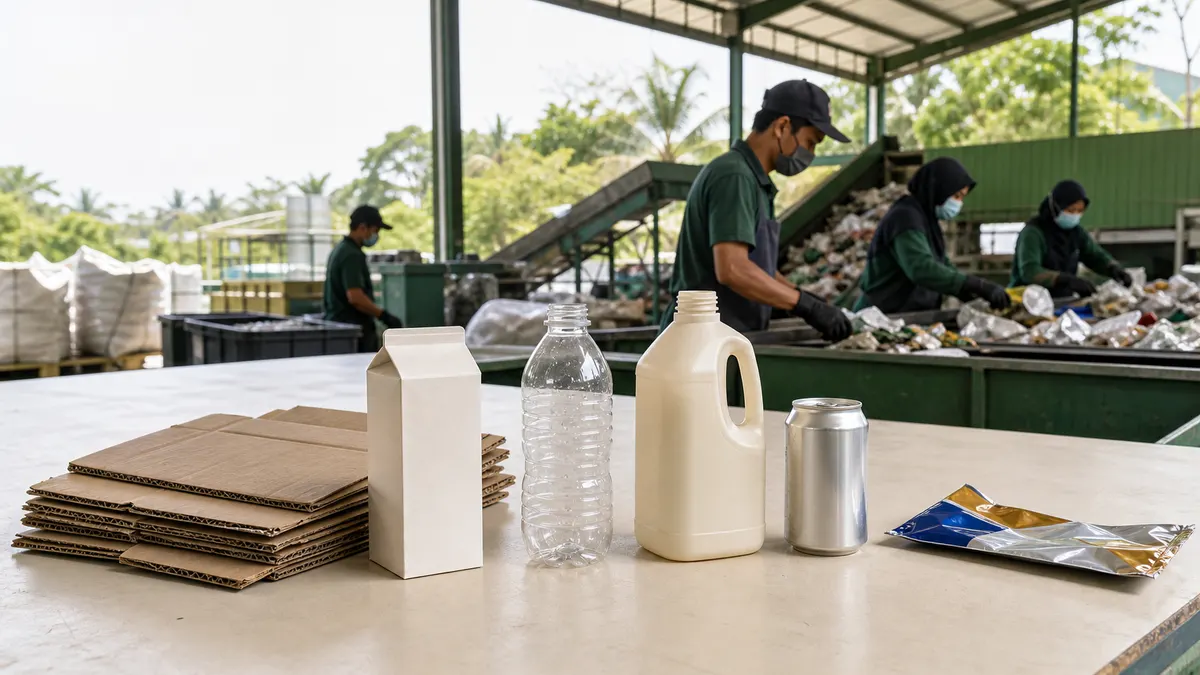
Two packages made from the same plastic can enter the same bin and still have completely different outcomes. For packaging designers, buyers, sustainability teams, and readers assessing disposal claims, understanding what makes packaging recyclable requires looking beyond the material name. The decisive question is whether a functioning local system can collect, sort, process, and sell that specific package after use.
Key takeaway: A package is recyclable in practice only when every link in its recovery chain works at commercial scale. Technical compatibility is necessary, but collection access, cleanliness, sorting performance, reprocessing capacity, and a buyer for the recovered material are equally important.
This guide explains what makes packaging recyclable in practice in Malaysia, including packaging collection and sorting, contamination, recyclable packaging design, commercial reprocessing, and demand for recovered materials.
Recyclable In Theory Is Not The Same As Recycled In Practice
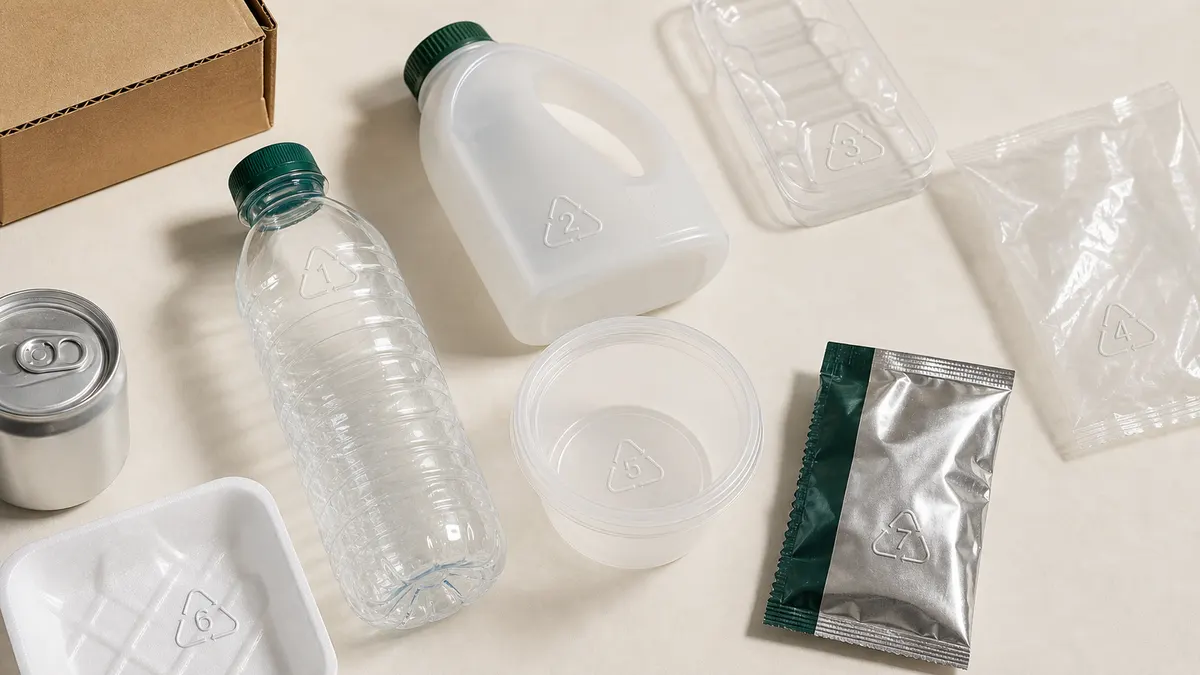
A resin identification code can describe the main plastic in a package. It does not prove that the complete package will be accepted, captured, or turned into usable material in a particular location.
This is the central difference between technical recyclability vs practical recyclability. Technical recyclability asks whether suitable equipment could process a material under controlled conditions. Practical recyclability asks whether the real system serving the intended user routinely carries the package from disposal to a usable secondary raw material.
A credible answer to what makes packaging recyclable therefore requires four conditions:
- The material is collected for recycling and has enough market value or mandated support to sustain collection.
- The package can be sorted into a defined recycling stream.
- Commercial facilities can reprocess it at an acceptable yield and cost.
- The recovered output is used as raw material for new products.
Consumer participation, collection, sorting, washing, drying, separation, shredding, quality control, and manufacturing demand all belong to this end-to-end system. A successful laboratory test or design assessment covers only part of the journey.
A material may be recyclable. A package is recyclable only within a system that can recover it.
This distinction matters because a technically accurate but unqualified claim can still mislead. Compatibility with an ideal process does not demonstrate likely recovery in a Malaysian municipality, an island community, or another Southeast Asian market.
The Practical Recyclability Chain Has No Optional Link
A useful evaluation follows the package in the same order that the recovery system encounters it. Failure at any stage interrupts the journey, even if every later stage is technically capable.
- Collection access: Can intended users place the package in an available collection channel?
- Participation and separation: Is the package likely to be emptied and kept apart from wet waste?
- Recognition and capture: Can workers or equipment identify and retain its actual size, shape, colour, and format?
- Stream compatibility: Can it join a defined material stream without degrading the recovered output?
- Commercial reprocessing: Can facilities wash, separate, shred, pelletize, pulp, or otherwise process it at viable cost?
- End-market use: Is a buyer able to use the resulting grade and quality?
This chain provides a practical anti-greenwashing test. Before describing packaging as recyclable, identify the geography, collection route, sorting stream, reprocessor, and likely outlet for the output.
Packaging Collection And Sorting Begin With Access
Collection for disposal is not necessarily collection for recycling. A general waste service may move packaging efficiently while mixing it with food, liquids, and other materials that reduce its recovery value.
Access can differ among households, institutions, shops, offices, factories, urban neighbourhoods, rural communities, and islands. National availability should not be assumed from a small number of drop-off points or commercial contracts.
Malaysia generated an estimated 2,000 kilotonnes of dry plastic waste in 2023, with roughly 22% collected for recycling. That figure should not be read as a measured recycling rate: treating every collected item as recycled probably overstates the amount that became secondary raw material.
The estimated collection-for-recycling rates also varied substantially by source:
- Household plastics: about 13%
- Institutional waste: about 10%
- Commercial waste: about 7%
- Industrial waste: about 80%
Industrial material is often concentrated at fewer sites and may be cleaner, drier, more consistent, and known by composition. Household and commercial streams can contain smaller quantities from many locations, mixed formats, product residue, and wet waste.
The surprise is that material chemistry may matter less at the first stage than logistics. A perfectly designed container cannot be recycled through a collection route that does not exist.
Packaging Contamination In Recycling Affects Yield And Cost
Contamination is not simply a question of whether a package looks tidy. It determines how much usable material survives processing and how much labour, water, energy, wastewater treatment, residue disposal, and quality control the recycler must provide.
Wet organic waste is especially damaging when mixed with dry recyclables. Food, liquids, dirt, and non-target items can spread across otherwise recoverable packaging during storage, compaction, and transport.
Malaysian plastics converters have reported difficulty obtaining food-grade recycled plastics because of high contamination. Keeping wet organic waste separate from dry recyclables could materially improve feedstock quality because organics are a principal contaminant in recyclables recovered from municipal waste.
Instructions should match the actual collection and processing system. “Empty and reasonably clean” may be appropriate for some routes, while excessive washing can waste water without improving acceptance. Clear, realistic instructions are more useful than a universal demand for spotless packaging.
Sorting Responds To The Package, Not Just Its Polymer
Sorting systems encounter a physical object rather than a material specification. They may use three-dimensional form, size, weight, colour, optical signature, magnetic response, electrical properties, and density to decide where that object goes.
Small closures and fragments can fall through screens or be lost during transfer. Flat films can wrap around machinery, move unpredictably, attract residue through static, or enter a stream configured for rigid containers or paper.
Material recovery facilities for packaging can aggregate dry materials, separate defined streams, produce marketable bales, and control output quality. Optical sorting and other equipment can improve throughput when there is enough suitable feedstock to justify the investment.
Formal sorting in Malaysia has often relied on segregation at collection sites and transfer stations, an arrangement that has been described as inefficient. Dedicated facilities can improve productivity and consistency, but machinery cannot compensate for weak collection, severe contamination, or a missing buyer.
A package can therefore contain the “right” polymer and still deliver the wrong physical behaviour for the available sorting line.
Recyclable Packaging Design Evaluates The Whole Package
The dominant material is only the starting point. A complete assessment should include the body, cap, closure, label and adhesive compatibility, liner, seal, coating, ink, sleeve, pump, valve, handle, additives, and expected product residue.
Compatible components may remain together during processing. Incompatible components must detach reliably in the intended process or be removed before collection without creating another disposal problem.
| Component | Possible effect | Design question |
|---|---|---|
| Full-body sleeve | May hide the container from optical identification | Does it detach or allow reliable recognition? |
| PVC label on a PET bottle | Can contaminate the PET stream | Is a compatible label material available? |
| PET cap on a PP cup | Adds an incompatible polymer combination | Can the closure use a compatible material? |
| Aluminium top on an HDPE container | May remain attached and introduce non-target material | Does the seal separate in normal use or processing? |
| Pump with a metal spring | Combines materials in a small, complex assembly | Is the pump accepted, removable, and separately recoverable? |
| Non-releasing adhesive | May carry label material into the recovered output | Does it release under the intended washing conditions? |
These combinations have caused practical difficulties for Malaysian recyclers. Their effects depend on the target process, but they demonstrate why a claim based only on the package body can be incomplete.
Mixed Material Packaging Recycling Requires A Real Separation Route
Combining materials can provide barriers against oxygen, moisture, light, or leakage. Those functions may protect the product and reduce damage, but an inseparable structure may be rejected when no commercial process can divide its layers into useful outputs.
A removable component is not automatically a solution. Users need clear instructions, removal must be realistic, and the separated component needs its own viable destination. Otherwise, “remove before recycling” merely transfers the disposal problem.
Colour And Additives Can Change Recovered-material Value
Colour is rarely removed economically from recycled plastic. Once mixed, coloured material can restrict the output to darker products or applications with less demanding appearance requirements.
Some coloured PET bottles in Malaysia could not enter established outlets and behaved as contaminants in those streams. The polymer remained technically processable, but the available market could not use the resulting colour and quality.
Additives can also change physical behaviour. Calcium carbonate can increase the density of HDPE flakes, causing intended material to sink and be lost during float-sink separation. Affected Malaysian recyclers reported contamination losses rising from a normal 5% to as much as 20%.
Pigments may affect optical recognition, coatings may not release as intended, and additives may alter melt quality or downstream suitability. These effects should be verified against the intended recycling process rather than inferred from the polymer name.
Flexible Packaging Recyclability Faces Format-specific Barriers
Flexible packaging can use little material while delivering important product protection. Its low weight, however, also means that large numbers of packs may contain limited resale value.
Films can be difficult to capture on lines calibrated around rigid three-dimensional objects. They may escape screens, wrap around equipment, attract dirt through static, and be expensive to store or transport efficiently. Their high surface-area-to-weight ratio also makes food residue particularly significant.
A mono-material flexible pack may improve compatibility by removing inseparable layers. That improvement does not establish collection access, sorting capture, viable reprocessing, or demand for the output.
Material reduction should also be considered alongside packaging performance. A lighter structure that increases leakage, product damage, or food waste may shift environmental burdens rather than eliminate them. The appropriate comparison is between complete delivery systems that protect the same amount of usable product.
Packaging Recycling Infrastructure Is A Connected Network
A recycling plant is only one part of the required system. Practical recovery can depend on household or business collection, aggregation points, transfer stations, sorting capacity, balers, storage, transport, washing, drying, shredding or pulping, quality testing, and manufacturing outlets.
Each asset needs sufficient throughput and reasonably predictable feedstock. Facilities and transport routes struggle to operate economically when material arrives sporadically, in small quantities, or with highly variable composition.
As a hypothetical example, a remote island without regular separate collection or economical transport to a mainland reprocessor may have no viable recovery route, even for technically processable packaging. This illustrates the logistics test; it does not describe a verified Malaysian island programme. Aggregation and baling can reduce handling volume, but the operator still needs to confirm transport costs and a viable recycling market.
Similar principles can produce different solutions across Southeast Asia. Dense cities, industrial zones, dispersed rural communities, and islands may need distinct collection and logistics models. Access can also vary within the same country, so a national claim may conceal important local gaps.
Demand For Recycled Materials Completes The Chain
Collected material is not the final product. Reprocessors must sell an output whose value can contend with collection, sorting, transport, washing, energy, yield loss, testing, and disposal of rejected residue.
Demand is quality-specific. A buyer may require a particular polymer, colour, contamination limit, traceability level, mechanical performance, or suitability for a regulated application. Material that fails those requirements may have little value even when it can be melted or shredded.
In 2019, about 24% of the PET, LDPE, HDPE, and PP available in Malaysia was recycled. Only about 19% of the potential material value was captured, representing approximately US$234 million annually.
Practical barriers included gaps in domestic processing capacity, insufficient local demand requirements for recycled resin, weak design-for-recycling standards that contributed to low-quality feedstock, limited incentives for source separation, and municipal systems oriented more toward waste collection than recycling.
Market value or mandated support can sustain collection where the recovered material alone cannot cover system costs. Neither is sufficient by itself: valuable material still needs accessible collection, acceptable contamination, effective sorting, processing capacity, and a qualified buyer.
A Practical Checklist For Evaluating What Makes Packaging Recyclable
The strongest claims are built by tracing evidence across the whole route. Use the following questions before selecting a design, approving a specification, or publishing disposal guidance.
Questions For Packaging Designers And Buyers
- What is the complete material and component specification?
- Does the package protect the product adequately with the least problematic practical design?
- Is the body compatible with the intended recycling stream?
- Do labels, adhesives, closures, coatings, pigments, additives, pumps, and seals separate or remain compatible during processing?
- Can sorting systems identify and retain the package’s actual size, shape, colour, and format?
- Has the finished package been assessed using a recognized protocol relevant to the intended market?
Questions For Recyclability And Disposal Claims
- Which geography and collection system does the claim cover?
- Can the intended population access that collection route?
- Is the package sorted into a defined stream at meaningful yield?
- Is it commercially reprocessed rather than merely collected?
- How much becomes usable secondary raw material after process losses?
- Is there a stable buyer for that particular grade and quality?
- Must users empty, rinse, separate, return, or remove components, and are those instructions realistic?
More Accurate Claim Language
- Use qualified statements such as “accepted where this collection stream is available.”
- Where appropriate, state “designed for compatibility with the named process; local acceptance varies.”
- Do not present a resin code, laboratory result, pilot project, or isolated drop-off point as proof of widespread recovery.
- Keep “recyclable,” “collected for recycling,” and “actually recycled” separate because they describe different stages.
Frequently Asked Questions
Does A Recycling Symbol Prove That Packaging Will Be Recycled?
No. A symbol or resin code can help identify a material, but it does not establish local collection, sorting performance, commercial processing, or demand for the recovered output.
Is Mono-material Packaging Always Recyclable?
No. A mono-material structure can remove compatibility problems, but it may still be too small, contaminated, unsupported by collection, difficult to sort, or unwanted by local buyers.
Does Putting Packaging In A Recycling Bin Mean It Was Recycled?
No. It means the item entered a collection channel. It may later be rejected during sorting, lost during processing, or produce material that does not meet a buyer’s requirements.
Should Consumers Rinse Every Package?
Packages should generally be emptied and prepared according to the instructions for the actual collection route. A light rinse may help in some systems, but excessive washing is not a substitute for local acceptance or compatible design.
Can Packaging Be Recyclable In One Place But Not Another?
Yes. Collection contracts, sorting equipment, reprocessing capacity, transport distances, and material markets vary by location. A claim that is supportable for one system may not apply elsewhere.
The Practical Standard For Packaging Recycling In Malaysia
For readers deciding what makes packaging recyclable, the most important action is to ask for evidence at every stage. A material specification is the beginning of that inquiry, not the conclusion.
Before approving a claim, ask suppliers, collectors, sorters, reprocessors, and material buyers to confirm the intended route. If one link cannot be demonstrated, qualify the wording and consider a design, collection method, or delivery model with a more credible recovery pathway.
Practical recyclability is a property of a package within a functioning system, not an intrinsic promise made by the material alone.