Eco Pack Friend Editorial Team
How Labels Affect Packaging Recyclability: A Malaysia-Focused Design Guide
A recyclable bottle can become difficult to sort, wash, or reprocess because of its label. This guide explains how label coverage, sleeves, adhesives, inks, coatings, and material choices affect packaging recyclability in Malaysia.
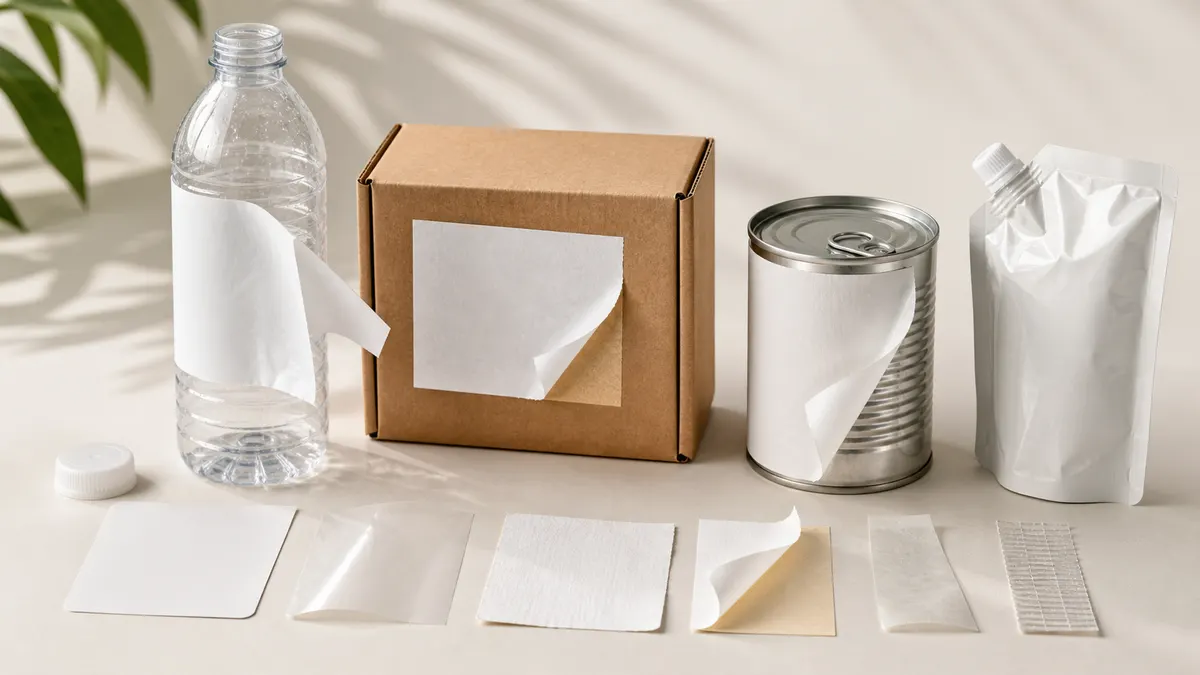
A recyclable bottle can become difficult to sort, wash, or reprocess because of its label. This guide explains how label coverage, sleeves, adhesives, inks, coatings, and material choices affect packaging recyclability in Malaysia.
For packaging designers, converters, and businesses specifying labels, understanding labels and packaging recyclability means evaluating the container, label or sleeve, adhesive, inks, coatings, and decorative elements as one finished package—not as separate materials.
Key takeaway: A label should help sorting equipment identify the package, separate under the recycler’s operating conditions, and leave no damaging residue. Even then, compatible design does not guarantee that the package will be collected or recycled in every Malaysian locality.
Quick Answer: Check Five Label Features First
For a fast packaging review, check these five features before comparing detailed supplier claims:
- Visibility: Can sorting equipment see enough of the primary container to identify it?
- Separation: Does the complete printed label separate from the container in the intended process?
- Adhesive behaviour: Does the adhesive release cleanly without remaining on or redepositing onto recovered material?
- Decoration: Could ink, foil, metallic pigment, coating, or opacity interfere with detection or recyclate quality?
- Local route: Is the finished package collected and processed by a confirmed operator in the target Malaysian locality?
Decision rule: If the primary container cannot be identified, the label cannot be separated or safely retained, or no local recovery route exists, do not make an unqualified recyclability claim.
A Recyclable Container Can Be Undermined By Its Label
The clearest answer to how labels affect packaging recyclability is that they can interfere at several different stages. A label may discourage correct consumer separation, conceal the container from optical sensors, remain attached during washing, travel with the wrong material during density separation, or introduce colour and residue during extrusion.
The recycling unit is the finished package, not the resin named on the container.
This distinction matters in Malaysia. A historical national market study estimated that about 24% of the PET, LDPE, HDPE, and PP available in the country was recycled in 2019. Better label design can reduce technical barriers, but it cannot create collection, sorting and viable markets for recycled material where these are absent.
A recycling symbol, a supplier declaration, or a recyclable container resin may support part of a claim. None proves all three levels. Packaging teams should assess the assembled and decorated package against the real route expected to handle it.
Follow The Label Through The Recycling Process
A label that appears minor on a finished pack can become a significant contaminant after the pack is shredded into flakes. Following the package through the process makes the failure points easier to identify.
- Disposal and collection: The package must enter a recoverable stream. A technically compatible design has no recycling benefit if the local system does not collect that format.
- Sorting: Equipment or workers must identify the primary package correctly. A large, opaque, dark, or reflective label may conceal the container.
- Resin identification: Optical equipment may read the visible label instead of the resin underneath.
- Size reduction: Shredding turns the container, label, ink, and adhesive into a mixed stream of small pieces.
- Washing: Adhesive, ink, paper fibre, and coatings may release into wash water, remain on the plastic, or redeposit elsewhere.
- Material separation: Flakes may be separated by density. A label with the wrong finished density can travel with the container flakes instead of separating from them.
- Drying and extrusion: Remaining contaminants may cause discolouration, odour, black specks, filtration problems, stickiness, or material degradation.
- Recyclate assessment: The recovered material must be suitable for an intended application, not merely capable of passing through equipment.
Near-infrared sorting of packaging uses reflected light patterns to help optical equipment distinguish plastic types. The sensor can classify only the surface visible to it. If a sleeve dominates that surface, the equipment may identify the sleeve, classify clear PET as coloured material, or fail to make a positive identification.
Diagnose The Failure Before Changing The Label
A practical way to avoid unnecessary packaging changes is to match the observed failure to the component most likely to cause it. This separates a sortability problem from a washing, density, or recyclate-quality problem.
| Observed failure | Likely label-related cause | First useful check |
|---|---|---|
| Container is not positively identified | Excessive coverage, opacity, dark colour, reflection, or metallic decoration | Sort the finished package from multiple orientations |
| Label fragments remain with PET flakes | Finished-label density is too high or the label does not release | Test the printed, coated, and adhesive-bearing label in the defined wash and float-sink process |
| Flakes remain sticky after washing | Adhesive remains on the container or redeposits during washing | Record adhesive fate under the recycler’s temperature, alkalinity, dwell time, and agitation |
| Recovered resin is discoloured or speckled | Ink bleed, paper fibre, coating residue, or incompatible polymer contamination | Compare washed flakes and extruded recyclate from decorated and undecorated controls |
| A technically compatible pack is not recovered | No collection route, no sorter acceptance, or no commercial outlet | Confirm acceptance with the intended local operators before redesigning components |
This diagnosis prevents a common mistake: replacing the label substrate when the actual constraint is excessive coverage, an unsuitable adhesive, or the absence of a local collection route.
Label Coverage And Recycling Sorting: Visibility Matters
As a label becomes larger or more opaque, the risk of it hiding the primary package increases. An opaque full-body sleeve can prevent a clear PET bottle from being recognised correctly or cause it to enter a coloured-material fraction.
One established PET-bottle design guide treats label coverage of no more than 55% as preferred for containers of 550 ml or less. For larger containers, the preferred level is no more than 75%. Packages above those values require finished-package sortation testing under that guidance.
These percentages are external design references, not universal pass limits or verified Malaysian acceptance criteria. Equipment, operating settings, input quality, and commercial outlets for recovered material differ among facilities.
Practical Ways To Preserve A Readable Container Surface
- Reduce label area while retaining legally required and useful product information.
- Leave the container visible from several orientations rather than through only one narrow window.
- Avoid full-body opacity when a smaller or partly transparent construction can perform the same function.
- Check whether dark, reflective, or metallic decoration changes optical detection.
- Test production-ready samples rather than relying on artwork files or unconverted label film.
Consider a Malaysian beverage producer using the same clear PET bottle in two designs. A small wraparound label leaves most of the bottle visible, while an opaque full-body sleeve presents the sorting sensor with a different surface. The first design may be easier to identify, but neither should be called locally recyclable until the relevant collector and recycler confirm the format and the completed package is tested where necessary.
Match The Label Material To The Container And Intended Stream
Label and container material compatibility describes how every component behaves within a specified sorting, washing, separation, and reprocessing system. It does not necessarily mean that the label and container should be made from identical polymers.
The appropriate recyclable packaging label materials depend on the primary pack and the intended process. A construction that works on PET may be unsuitable for HDPE, flexible PE, or a fibre pack.
| Container or stream | Potentially preferable construction | Common risks | Evidence to request |
|---|---|---|---|
| PET bottles and thermoforms | Finished polyolefin film label demonstrated to float while PET sinks | PVC or PLA sinking with PET; adhesive residue; ink bleed; paper fibre | Finished-label density, wash test, separation result, and recyclate-quality assessment |
| Rigid HDPE | Label and adhesive shown to release or remain compatible under the target wash process | Persistent adhesive, fibre loss, incompatible polymer, or excessive non-plastic coverage | Named rigid-HDPE protocol, wash temperature, release result, and operator confirmation |
| Rigid PP | Construction tested for the intended rigid-PP process | Label fragments or adhesive remaining with PP; optical misclassification | Complete-package sortation and washing evidence |
| Flexible PE or PP | Components compatible with the main flexible-polymer stream | PET, PETG, PS, or PLA labels and sleeves contaminating defined PE or PP streams | Local collection route, recycler input specification, and stream-specific test results |
| Paper and fibre packaging | Label, coating, and adhesive demonstrated to behave acceptably in repulping | Plastic film residue, screens clogged by adhesive, unrecovered fibre, or excessive rejects | Repulpability, screening, residue, and yield results for the assembled pack |
PET Bottles And Thermoforms
In a typical PET density-separation step, PET flakes sink in water while suitable polyolefin label fragments float. This can allow the label material to be separated from PET, but only if the entire printed and adhesive-coated label retains the required density.
Inks, coatings, and adhesive can change whether the complete label floats or sinks. Density evidence for bare film is therefore incomplete. PVC- and PLA-containing labels are highly problematic in this context because they may sink with PET and can damage recycled-PET quality even at low contamination levels.
When evaluating recyclable labels for PET packaging, request evidence covering the actual substrate, printing, coatings, adhesive coat weight, and application area. Do not assume the same construction is accepted by every PET recycler.
Rigid HDPE And PP
For rigid HDPE and PP, both the label substrate and adhesive behaviour matter. European technical guidance uses water-soluble or water-releasable label-and-adhesive combinations at 40°C in its assessment context. That temperature and process should not be described as a verified operating condition for Malaysian recyclers.
Flexible PE And PP Packaging
Defined European flexible-packaging streams identify PET, PETG, PS, and PLA labels or sleeves as incompatible with PE and PP recycling. This is a useful design warning, not evidence that a flexible pack will be collected in Malaysia. Local collection and processing availability for flexible plastics can vary substantially by material, format, location, and operator.
Paper And Fibre-based Packs
A paper label is not automatically the best choice for a paper pack. Label films, release coatings, wet-strength treatments, and adhesives can affect pulping, screening, fibre yield, and reject levels. The full pack should be assessed in the intended fibre-recovery process.
Sleeves, Metallic Decoration, And Reflective Features Can Disrupt Detection
Full-body sleeves can dominate the optical signal used to classify a package. Metallic foils, metallised films, metallic coatings, and inks containing metallic pigments can also prevent positive detection of the underlying plastic.
Coverage and position matter. A small foil detail may behave differently from a metallised sleeve covering most of a bottle, but appearance alone cannot establish compatibility. Test whenever decoration could conceal the base resin or produce an uncertain optical response.
Removability Helps Only When It Works In Real Use
A tear strip or perforation can expose the underlying container, but “removable” should describe an observable user action rather than a theoretical feature. Consumers must be able to find the opening point, understand the instruction, and remove enough of the sleeve without special tools.
One European assessment system uses 50% non-plastic component coverage as a sortability criterion unless opening the pack necessarily removes the component and exposes at least half of the plastic surface. This illustrates the importance of exposure and reliable removal; it is not a Malaysian threshold.
The removed sleeve still needs a truthful disposal instruction. Directing it into the same stream as the container may recreate the contamination problem the tear strip was intended to solve.
Wash-off Adhesives For Recycling Need Defined Test Conditions
Wash-off adhesives for recycling are systems designed and tested to release under specified washing conditions. The term “washable” is incomplete without the temperature, alkalinity, dwell time, agitation, label construction, and ageing conditions used in the test.
For PET thermoforms, a preferred outcome is for adhesive to wash cleanly from PET and remain with the separated label. If adhesive stays on PET flakes or redeposits during washing, it may cause discolouration, stickiness, filtration problems, or defects during extrusion.
There is a functional trade-off. An adhesive must survive converting, filling, transport, cold-chain handling, retail display, and consumer use, yet release when it reaches the intended recycling wash. A weak adhesive that causes labels to detach during use is not a successful recycling design.
Recycling-compatible Inks And Adhesives Are Complete Systems
Recycling-compatible inks and adhesives are systems demonstrated to behave acceptably under the relevant protocol. Broad environmental language or a claim about one raw material does not establish the performance of a printed, coated, converted, and applied label.
For suitable PET-label constructions, ink-retentive technology can keep ink attached to a floatable label during caustic washing. An appropriately designed de-inking system takes a different route by releasing ink as particles that the process can remove.
Ink that dissolves or bleeds may discolour wash water, transfer colour to recovered resin, and increase filtration or wastewater-treatment demands. Varnishes, barrier coatings, heavy decoration, and metallic pigments can add further effects.
Supplier Checklist For Printed Labels
- Ink chemistry and expected behaviour in the named wash process.
- Coating type and coat weight.
- Metallic pigment, foil, or metallised-layer content.
- Bleed, staining, and wash-water results.
- The effect of printing and adhesive on finished-label density.
- Measured colour or quality effects on the resulting recyclate.
Testing an unprinted substrate is not enough. Production printing, coatings, lamination, adhesive, and package ageing can change the result.
Paper Labels Are Not Automatically Compatible With Plastic Recycling
Replacing a plastic label with paper may shift contamination rather than eliminate it. On PET, paper can pulp during hot caustic washing, adding fibres to the wash system and increasing filtration and wastewater-treatment loads.
Residual fibres may remain with PET flakes and carbonise during extrusion, creating dark defects in recycled material. For rigid HDPE and PP, European guidance similarly seeks to avoid fibre loss during its specified wash process.
Possible Design Responses
- Reduce the area of the paper label.
- Use a label-and-adhesive construction tested on the intended container.
- Consider a separable film label where the target process supports it.
- Confirm whether the intended Malaysian recycler accepts the paper-labelled format.
The correct comparison is not “paper versus plastic” in isolation. It is the measured behaviour of each complete construction in the intended recovery system.
Compostable Labels Require Finished-package Evidence And A Real Route
A compostable base package does not automatically make its label, ink, coating, or adhesive compostable. ASTM D6868 provides a finished-product framework for biodegradable plastic film or sheet attached to another substrate. The entire product must compost satisfactorily without reducing compost quality.
North American certification processes may also require printed-product applications to document ink percentage, provide safety information, and complete metals testing. These requirements illustrate the level of construction-specific evidence needed; they do not prove certification acceptance or access to industrial composting in Malaysia.
Industrial-composting and home-composting claims are not interchangeable. Operators use different conditions and accepted feedstocks, and a certification does not create a local collection route.
A package should not be described as suitable for any bin or as able to decompose harmlessly in uncontrolled environments. Those claims go beyond what controlled compostability testing demonstrates.
A Verification Workflow For Labels And Packaging Recyclability
The most useful workflow moves from the local recovery route back to the package specification. This avoids optimising a label for a theoretical process that does not handle the product in its target market.
- Identify the primary pack. Record the container resin or fibre, colour, format, volume, closures, coatings, and intended Malaysian market.
- Verify the available route. Ask which collectors, sorters, and recyclers serve that product format and location.
- Shortlist compatible components. Compare label substrates against the intended sorting, washing, and separation process.
- Minimise interference. Reduce coverage and avoid unnecessary opacity, metallic decoration, and mixed materials.
- Specify process behaviour. Define adhesive release, label density, ink retention or removal, and coating behaviour under named conditions.
- Test the complete package. Assess the decorated and aged pack for sortability, separation, wash performance, and recyclate quality.
- Check safety separately. Food-contact and product-safety compliance do not prove recyclability, and recyclability testing does not prove food-contact compliance.
- Record claim limits. Store the protocol, result, package version, geographic scope, operator confirmation, and review date.
An Evidence Hierarchy For Packaging Decisions
- Strongest: Finished-package testing under a recognised protocol, supported by confirmation from the intended collector or recycler.
- Useful but incomplete: Component certificates and supplier declarations tied to named methods and the exact package construction.
- Weak: Generic resin claims, an unqualified recycling symbol, or an assertion based only on the container material.
Packaging Recyclability In Malaysia Depends On Present Local Conditions
National evidence and policy targets provide context, but neither acts as a current acceptance directory. The 2019 estimate that about 24% of four key plastic resins was recycled shows why technical compatibility and real recovery must be assessed separately.
Malaysia’s Plastics Sustainability Roadmap 2021–2030 includes targets for 100% recyclability of plastic packaging and a 76% average collected-for-recycling rate by 2030. These targets describe policy direction. They do not establish that every packaging format, label material, or treatment route is presently accepted nationwide.
Conditions elsewhere in Southeast Asia should also be kept separate. Infrastructure, specifications, material values, accepted inputs, and operator economics vary by country and facility. Evidence from a European or North American protocol can inform design, but local verification remains necessary.
Final Package Decision Checklist
- Can optical or manual sorting identify the primary package?
- Is the label coverage within the relevant tested limit?
- Does the complete printed label separate from the container as intended?
- Do the adhesive and ink remain controlled during washing?
- Could fibres, metallic layers, PVC, PLA, PETG, or PS contaminate the intended stream?
- Has the package been tested after printing, conversion, filling, storage, and ageing?
- Is there a verified collection and processing route in the target Malaysian locality?
- Is every recyclability or compostability claim limited to what the evidence proves?
Frequently Asked Questions
Does A Recycling Symbol On The Container Prove The Labelled Package Is Recyclable?
No. A symbol may identify the container resin, but it does not prove that the finished package can be sorted, washed, separated, and reprocessed in a particular locality.
Is A Smaller Label Always Better?
Lower coverage generally leaves more of the container visible, but size is only one factor. Substrate, opacity, density, inks, metallic content, adhesive, and the target process still need assessment.
Should A PET Bottle Use A PET Label?
Not automatically. In PET density separation, a suitable finished polyolefin label may float away while PET sinks. A PET-based label that remains with bottle flakes can be difficult to distinguish and may affect recyclate quality, depending on its construction and the process.
Can Consumers Solve The Problem By Removing Every Label?
Consumer removal can help only when instructions are clear, removal is reliable, and the separated components have valid disposal routes. Design should not rely on a difficult or easily missed action without evidence of how the package is actually used.
Does European Compatibility Guidance Prove Acceptance In Malaysia?
No. It can provide a useful technical benchmark, but Malaysian collectors and recyclers may use different equipment, wash conditions, input specifications, and commercial acceptance rules.
How Often Should Compatibility Evidence Be Reviewed?
Review it whenever the container, label film, adhesive, ink, coating, supplier, artwork coverage, or target recovery route changes. Time-sensitive operator acceptance should also be reconfirmed before renewing a public claim.
The Practical Next Step
Ask the container, label, ink, coating, and adhesive suppliers for construction-level specifications tied to named tests. Then verify the finished, decorated, and aged package with the intended Malaysian collection or recycling partner before making a claim about labels and packaging recyclability.
References
- Association of Plastic Recyclers — PET Rigid Packaging Design Features
- Association of Plastic Recyclers — PET Thermoform Packaging Design Resources
- Association of Plastic Recyclers — Near Infrared Sorting in the Plastics Recycling Process
- RecyClass — Is Your Label Compatible with HDPE and PP Container Recycling?
- World Bank — Market Study for Malaysia: Plastics Circularity Opportunities and Barriers
- Malaysia Plastics Sustainability Roadmap 2021–2030