Eco Pack Friend Editorial Team
How To Read Packaging Recycling Symbols In Malaysia: Codes 1–7 And Other Marks
This guide explains how to read packaging recycling symbols in Malaysia, including plastic recycling symbols 1–7, the Möbius loop, Green Dot, FSC, Tidyman and compostability marks.
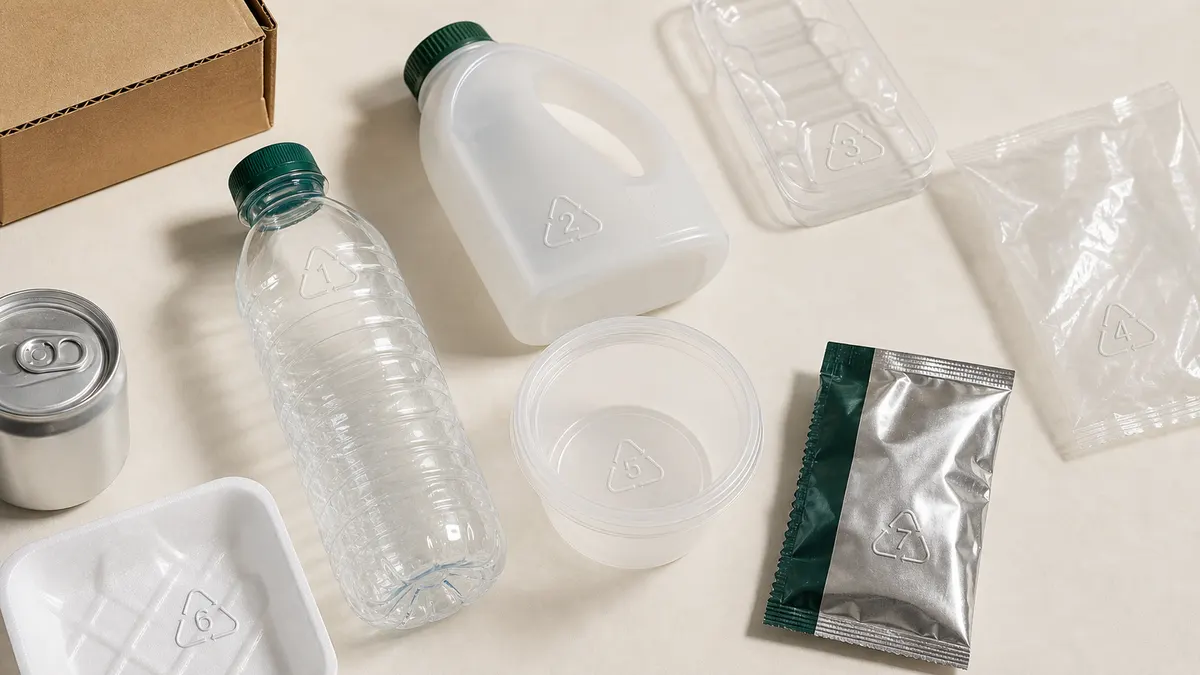
This guide explains how to read packaging recycling symbols in Malaysia, including plastic recycling symbols 1–7, the Möbius loop, Green Dot, FSC, Tidyman and compostability marks.
A triangle of arrows can identify a plastic without proving that anyone will recycle it. For Malaysian consumers, food sellers, retailers and packaging buyers, the safest way to read packaging recycling symbols is to identify what the mark actually covers, inspect the complete package and then confirm the precise format with the collector serving your location.
Similar-looking marks may communicate material identity, recyclability, recycled content, collection instructions, certified sourcing, compostability or nothing more than a reminder not to litter. They do not automatically prove local collection, successful processing, food-contact suitability or lower environmental impact.
1. Start With The Symbol Category, Not Its Shape
Most packaging marks fit into five useful categories. Identifying the category prevents a familiar mistake: treating every loop, triangle or green graphic as proof that the complete package belongs in recycling.
| Mark | What it communicates | What it does not prove | What to check next |
|---|---|---|---|
| Material identification code | The principal material or resin family | That the complete item is collected or recyclable locally | Package format, components and collector acceptance |
| Recyclability or recycled-content claim | A defined environmental claim about the item or material | Access to collection or processing in your area | Claim qualifications and an accessible local route |
| Collection label | Preparation and sorting instructions for a specified programme or market | That the instructions apply in every country | The label’s geographic scope and local collector rules |
| Certification mark | Compliance with a defined sourcing or performance standard | Every environmental benefit or a local disposal route | Certification scope, validity and end-of-life conditions |
| Unsupported or commonly misread graphic | Possibly an informal claim, brand graphic or anti-litter message | Material identity, certification or recyclability | Supporting specification, standard or programme owner |
The central rule is simple: packaging recycling symbols communicate only what their defined schemes cover. If a supplier cannot identify the scheme, scope or evidence behind a mark, do not infer a broader environmental benefit from its appearance.
2. Read Plastic Resin Identification Codes 1–7 Correctly
The numbered triangle on plastic is a Resin Identification Code. These plastic resin identification codes identify the principal plastic resin; they are not seven promises that an item can enter a recycling programme.
People searching for recycling symbols 1–7 are therefore often looking at material identifiers rather than disposal instructions.
| Code | Abbreviation | Material family | Interpretation limit |
|---|---|---|---|
| 1 | PET | Polyethylene terephthalate | Material identity does not guarantee acceptance of every PET format. |
| 2 | HDPE | High-density polyethylene | Colour, closures, labels, residue and package form can affect acceptance. |
| 3 | PVC | Polyvinyl chloride | The code identifies resin, not a disposal route. |
| 4 | LDPE | Low-density polyethylene | Films and rigid items may follow different collection rules. |
| 5 | PP | Polypropylene | Acceptance varies by collector and package construction. |
| 6 | PS | Polystyrene | Rigid and expanded formats can face different practical limits. |
| 7 | Other | Other resins or certain combinations | Code 7 is not one material and requires product-specific information. |
PET 1, HDPE 2 and PP 5 are commonly recycled in Malaysian practice. That is useful general guidance, but it does not mean every collector accepts every bottle, tray, tub, film or composite package made with those resins. Published practical guidance is based mainly on partner practices in Klang Valley and should not be treated as proof of nationwide access.
Format matters because recycling systems handle physical articles, not resin numbers in isolation. A clear PET beverage bottle may fit an established collection and sorting stream, while a PET-containing multilayer tray may include bonded materials that cannot be separated economically. An LDPE film and an LDPE rigid closure can also encounter different equipment, demand and collection rules.
3. A Resin Number Is Not A Food-safety Instruction
Resin identity alone does not establish whether packaging is suitable for reheating, freezing, repeated use or contact with hot, cold, acidic or oily food. Food packaging is designed around intended contents and conditions, and different plastic articles made from the same broad resin family can have different formulations, manufacturing histories and performance limits.
Follow the manufacturer’s intended-use, temperature and food-contact instructions. Do not infer microwave suitability, repeated-use suitability or safe hot filling from the triangle number.
For example, a Malaysian food seller considering a PP container should request the supplier specification for the intended filling temperature, duration of contact, oil exposure and storage conditions. The seller should also determine whether the container, lid and any seal are covered by the same use conditions.
“Resin 5,” “recyclable” and “food-contact suitable for this application” are three separate claims requiring three separate forms of evidence.
4. Distinguish Recyclability From Recycled Content
The Möbius loop recycling symbol is commonly used for a recyclability claim. Under the relevant self-declared environmental-claims framework, an unqualified loop means recyclable, while a percentage displayed with the loop states the proportion of recycled content.
| Claim | Question it answers | Evidence still needed |
|---|---|---|
| Recyclable | Could the item enter a suitable end-of-life process under the claim’s stated conditions? | Local collection, sorting, processing and market access for the exact format |
| 30% recycled content | How much recycled material was incorporated into the package? | Basis of calculation, applicable component and supporting documentation |
A “30% recycled content” statement does not mean that 30% of the package will be recycled after disposal. It describes material already incorporated into the item. Likewise, a technically valid recyclability claim does not create a collection service or processing facility in the reader’s locality.
This separation between claim meaning and real access is essential when assessing sustainable packaging claims that need evidence. A claim can be accurately defined yet offer little practical local value if the necessary route is unavailable.
5. Check The Market Behind Collection Labels
Collection labels may name components, show preparation steps and give bin instructions. Those directions are usually designed around a specific programme or geographic market rather than a universal recycling system.
For example, How2Recycle is built for the United States and Canada, using recycling-access data for those countries. A label on imported packaging may still contain useful component information, but it cannot by itself establish Malaysian acceptance.
Instructions such as “remove film,” “empty and replace cap” or “store drop-off” should be followed only when they are relevant to an available programme and do not conflict with the accepting Malaysian collector’s requirements. A named overseas drop-off stream is not evidence that an equivalent route exists nearby.
6. Recognise Marks That Are Not Disposal Instructions
Green Dot: A Financing Mark
The Green Dot symbol meaning is frequently misunderstood. It indicates a financial contribution to an applicable European packaging-recovery organisation. It is not an ecolabel, material identifier or instruction to place the package in a Malaysian recycling stream.
A package bearing the mark may or may not be recyclable in a given location. Its presence does not settle that question.
FSC: A Sourcing And Chain-of-custody Mark
The FSC label meaning concerns forest-based sourcing and chain of custody. FSC 100% identifies material from FSC-certified forests; FSC Recycled identifies recycled forest-based material; and FSC Mix can include material from FSC-certified forests, recycled material and controlled sources under the scheme’s rules.
These labels do not prove that a coated, laminated or food-contaminated paper package is accepted locally. A printed carton can have valid fibre-sourcing certification while its polymer window, barrier coating, adhesive or attached insert requires a separate end-of-life assessment.
Tidyman: An Anti-litter Reminder
The pictogram showing a person placing waste in a bin asks people not to litter. It does not identify the packaging material, certify recyclability or specify a sorting stream. The correct destination could be recycling, another recovery route or general waste, depending on the item and available services.
7. Keep Biobased, Biodegradable And Compostable Claims Separate
The phrase biodegradable vs compostable packaging compares related but different claims. Biodegradability describes breakdown under stated environmental conditions and over a relevant period. Compostability requires performance against defined composting conditions and criteria, including disintegration and effects on the resulting compost.
Biobased describes the origin of some or all feedstock. A biobased plastic is not necessarily biodegradable or compostable, and a biodegradable material is not automatically suitable for either home or industrial composting.
The Seedling compostable packaging symbol certifies industrial compostability to EN 13432 under controlled temperature, moisture and time conditions. It does not mean that the item is home-compostable, compatible with ordinary plastic recycling, safe to litter or accepted by a nearby facility.
The international standard ISO 18606:2013, reviewed and confirmed in 2024, sets requirements for packaging that can be recovered through organic recycling such as industrial composting, and every part of the pack must meet them. It does not apply to composting in small household installations, and it does not cover packaging that ends up as litter.
Certification supplies evidence about performance under specified conditions. It does not supply a Malaysian collection service. Use a composting route only when a collector or facility explicitly accepts that certified package type.
8. Inspect The Whole Package
Recycling decisions are affected by more than the main body material. Laminates, barrier coatings, metallised layers, windows, pumps, labels, adhesives, inks and attached closures can change how an item sorts or processes.
Single-material plastics are generally more recyclable in Malaysian practice than mixed or multilayer formats. Even then, collection volume, material value, contamination and facility capability influence whether a route works in practice. The distinction is explored further in this guide to what makes packaging recyclable in practice.
| Package | What to inspect | Question for the collector |
|---|---|---|
| Clear PET drink bottle | Bottle body, cap, sleeve or label, adhesive and residue | Is this bottle format accepted, and should the cap or sleeve be removed? |
| Paperboard takeaway box | Polymer lining, grease, food residue, window and adhesive | Does the paper stream accept this coating and level of contamination? |
| Flexible snack pouch | Bonded plastic, aluminium or metallised barrier layers | Is this exact flexible multilayer format collected? |
| Pump bottle | Bottle resin, pump plastics, tube and metal spring | Should the pump be removed, and which remaining components are accepted? |
For each item, ask whether the components can be separated safely and easily, whether the collector requests separation and whether the remaining parts are accepted in those exact formats. Do not dismantle components based on guesswork if doing so could cause injury or contaminate an otherwise acceptable stream.
9. How To Recycle Packaging Using A Malaysian Checklist
Use the following sequence whenever packaging recycling symbols or broad environmental claims leave room for doubt:
- Identify the materials. Find the material name, resin code and labels for separate components.
- Classify each mark. Decide whether it is identification, a recyclability or recycled-content claim, a market-specific collection instruction, certification or an anti-litter graphic.
- Inspect the construction. Look for bonded layers, coatings, residue and components made from different materials.
- Read the qualifications. Check preparation directions, intended-use limits, geographic scope and any wording around the mark.
- Confirm locally. Ask the actual council service, concessionaire, drop-off point, waste picker network or commercial collector whether it accepts that material in that exact format.
- Prepare as requested. Empty the package, then clean and dry it to the collector’s required level. Residue can increase processing effort and cost.
- Separate only as directed. Remove caps, sleeves, pumps, windows or films when the accepting programme asks for it.
- Use the confirmed route. Do not place compostable plastic, flexible film or mixed-material packaging into a stream based only on a generic symbol.
Printable decision sequence: What is it made from? → What exactly does the mark claim? → Is the package single-material and sufficiently clean? → Does my collector accept this precise format? → What preparation does that collector require?
10. Common Questions About Recycling Marks
Does A Number Inside A Triangle Mean The Item Is Recyclable?
No. The number identifies the principal resin family. Local recyclability depends on the package format, other components, condition and the accepting collector’s capabilities and rules.
Does Code 5 Mean A Container Is Microwave-safe?
No. Code 5 identifies polypropylene, but it is not a temperature or food-use instruction. Follow the manufacturer’s specifications for the exact container, lid and intended application.
Does The Green Dot Mean Recyclable?
No. It is associated with financing an applicable European packaging-recovery organisation. It does not prove recyclability or provide Malaysian sorting instructions.
Can Industrially Compostable Packaging Go Into A Home Compost Bin?
Not unless the package carries separate evidence for home composting and the stated conditions can be met. Industrial certification relies on controlled conditions that a home compost system may not provide.
Should Packaging Be Washed Before Recycling?
Emptying, cleaning and drying commonly improves material quality and reduces contamination, but preparation requirements vary. Avoid wasting excessive water and follow the instructions of the collector accepting the package.
Can I Rely On Guidance From Klang Valley For Another State?
Use it as a starting point, not a guarantee. Confirm the material and package format with the service, centre or collector operating in your locality.
11. Make Verification The Final Habit
Packaging recycling symbols are evidence inputs, not universal disposal commands. Read the defined meaning first, inspect the complete construction second and treat local collector confirmation as decisive.
Common acceptance of PET 1, HDPE 2 and PP 5 is useful Malaysian guidance, not a nationwide guarantee. Consumers and SMEs can keep the package or take clear photographs of its body, components and marks when asking for confirmation.
For procurement, request the material specification, component breakdown, applicable certification details and evidence of an accessible end-of-life route in the intended Malaysian market. This shifts the decision from a vague green impression to verifiable package conditions.
Next step: Compare the symbol with the package specification, then verify the exact material and format with the collector serving your location before choosing a disposal route.