Eco Pack Friend Editorial Team
Sustainable Packaging Claims That Need Evidence
A green claim can fit on the front of a package, but the proof rarely does. For brands, packaging buyers and Malaysian SMEs, sustainable packaging claims are defensible only when evidence supports the exact package, wording, market, time period and meaning a reasonable customer is likely to take from the claim.

A green claim can fit on the front of a package, but the proof rarely does. For brands, packaging buyers and Malaysian SMEs, sustainable packaging claims are defensible only when evidence supports the exact package, wording, market, time period and meaning a reasonable customer is likely to take from the claim.
Terms such as recyclable, recycled, biodegradable, compostable, renewable, plastic-free and carbon-neutral describe different attributes. None of them proves that the package is environmentally preferable overall.
The practical rule: define what the claim covers, prove the relevant conditions, state important limitations beside the claim and verify the real disposal route where the package will be sold. When the evidence is narrow, make the claim narrow.
Every Environmental Claim Needs Evidence And Conditions
A package may have several environmental attributes, each with a different evidence requirement. A recycled-content carton is not necessarily recyclable. A bio-based film is not necessarily biodegradable. An industrially compostable bowl may have no practical composting route in the place where it is used.
This distinction matters in Malaysia because material availability and collection, sorting, recycling or composting access can differ by state, municipality, commercial waste arrangement and packaging format. Evidence from one collector or facility cannot automatically support a nationwide disposal instruction.
This guide to sustainable packaging claims in Malaysia explains the evidence required for recyclable, recycled-content, biodegradable, compostable, renewable, plastic-free and carbon-neutral packaging before a claim appears on labels, artwork or marketing materials.
This guide examines the most common claims and shows what a packaging team should have on file before artwork is approved.
Why The Wording And Overall Consumer Meaning Both Matter
Malaysia’s Trade Descriptions Act 2011 can apply when a trade description is materially false. It can also apply when wording is technically accurate but likely to communicate a materially false meaning. Proof must therefore support both the literal words and the overall impression created by nearby text, symbols, colours and images.
For example, “paper bottle” may accurately describe the visible outer shell while leaving consumers with the impression that the complete bottle contains no plastic. If it has a polymer liner, closure and adhesive system, the unqualified presentation may convey more than the construction data supports.
Important qualifications should be clear and adjacent to the claim. Hiding a limitation in a technical document, at the end of a QR-code journey or in small-print terms is unlikely to correct a stronger message on the front of the package.
Use A Substantiation Framework, Not A Collection Of Slogans
ISO 14021 packaging claims provide a framework for assessing self-declared environmental statements made with words, symbols or graphics across packaging, advertising and digital channels. The assessment methodology should be documented and retained.
A supplier declaration can form part of the evidence file, but it does not remove the brand owner’s responsibility to understand the declaration’s scope. The document may cover a raw material rather than the converted package, a previous formulation rather than the current one, or manufacturing in a market with different disposal conditions.
Malaysia packaging claim requirements should be identified from applicable Malaysian law and jurisdiction-specific programmes. Guidance from other countries can help teams judge disclosure quality, but it should not be presented as Malaysian law.
“A material property is not a disposal route, and a certificate is not proof of local collection.”
Build An Evidence File Before Approving The Artwork
The most efficient time to challenge a claim is before it is printed on thousands of packs. Start with a claim brief that identifies the exact statement, its intended location and the likely consumer takeaway.
Define The Subject Precisely
Record whether the claim applies to the complete package, primary container, secondary carton, label, closure, coating or another named component. Include the intended market, percentage basis, qualification and claim period.
A statement such as “bottle made with 30% recycled plastic” is more testable than “packaging made from recycled materials.” The first identifies a component, material and percentage. The second leaves all three unclear.
Retain The Records Behind The Claim
- The current bill of materials and finished-package specification
- Supplier declarations, purchase records and relevant certificates
- Laboratory reports and the test methods used
- Chain-of-custody and material-allocation records
- The approved artwork version and adjacent qualifications
- Collection, sorting, recycling or composting evidence for the target locality
Test records should identify the sample configuration, laboratory competence, pass criteria and date. They should also make clear whether testing covered the complete package or only a raw material.
Separate Facts, Assumptions And Trade-offs
A simple three-column record prevents optimistic assumptions from becoming marketing facts. Verified composition percentages belong under facts. Expected access to a planned collection programme belongs under assumptions until the programme is operational. Higher transport weight or reduced barrier performance may belong under trade-offs.
Set review triggers for formulation changes, supplier substitutions, certificate expiry, facility-access changes and entry into another state or Southeast Asian market. Evidence can become obsolete while the printed wording remains unchanged.
Recyclable: Prove A Practical Route For The Complete Package
Recyclable packaging evidence should show that the exact finished pack is compatible with relevant collection, sorting and reprocessing systems. It is not enough to show that the base fibre or resin can theoretically be recycled under ideal conditions.
Review the body, barrier coating, laminate layers, inks, adhesives, labels, sleeves, closures, pumps, size, colour and likely product residue. Any of these can affect whether the package is collected, recognised by sorting equipment, accepted by a reprocessor or converted into a usable output.
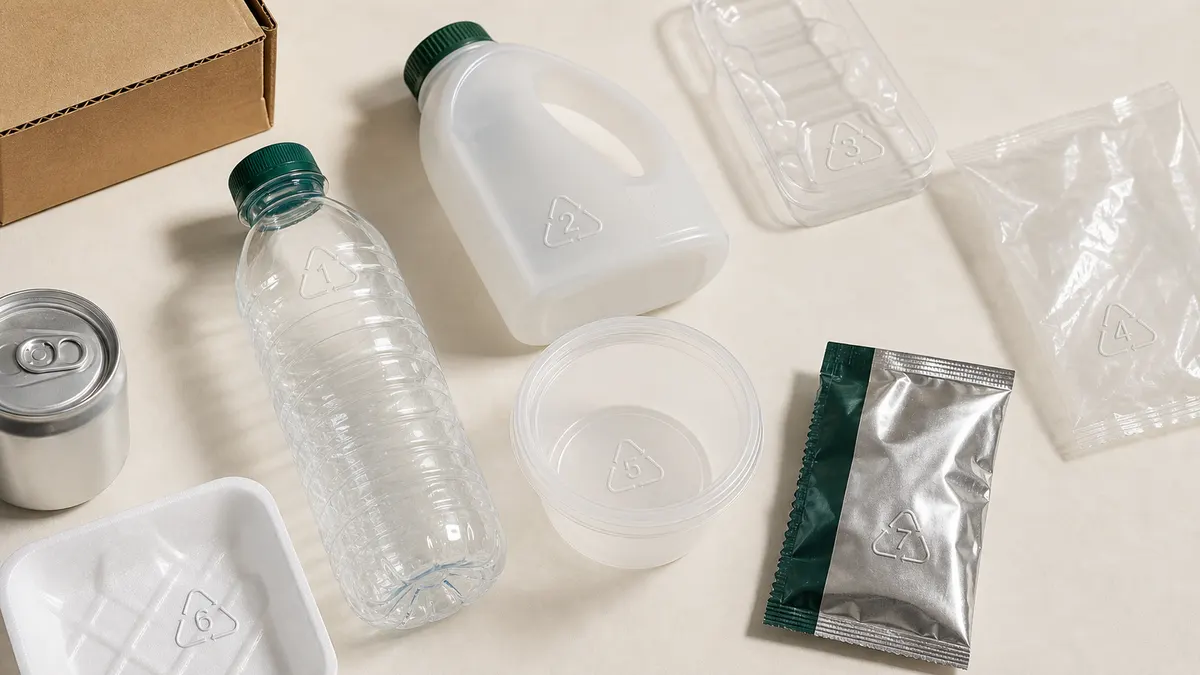
A resin identification code identifies a material category. It does not prove that local services collect the item, that sorting equipment captures its size or colour, or that a viable end market exists.
Investigate The Actual Malaysian Route
Check household collection, drop-off schemes and contracted commercial recovery separately. Record the operator, accepted package format, preparation requirements, service area and date checked. Evidence from one commercial collector should not be stretched into a claim of general household access.
A US disclosure benchmark uses 60% access when assessing whether an unqualified recyclable statement may be appropriate. That percentage can help a team think about claim qualification, but it is not a Malaysian legal threshold. Malaysian access requires its own evidence.
For a deeper examination of how collection, sorting, package design and demand interact, see what makes packaging recyclable in practice in Malaysia.
Example: A Lined Takeaway Cup
A Malaysian café uses a paper cup with a polymer lining and separate plastic lid. A recycler accepts clean paper cups from contracted commercial premises, but the municipal collection service does not list them. The lid is accepted at a separate drop-off point.
“Recyclable cup” would overstate the available evidence. A narrower instruction could identify the accepted component, required separation and locations served by the verified collection arrangement. It should be updated if the collector changes its acceptance policy.
Recycled Content: Verify The Percentage, Component And Custody Model
Recycled content claims should identify whether the percentage applies to the whole package, plastic bottle, paperboard body or another named part. The calculation should state whether coatings, labels and closures are included in the denominator.
Evidence should distinguish post-consumer material from pre-consumer material and demonstrate that the input was recovered or diverted from a waste stream. Useful records include purchase documents, supplier specifications, production records and chain-of-custody documentation.
Explain How Variation Is Handled
Recycled input may vary between production batches. State whether the claimed percentage is a minimum, a batch-specific result or an average over a defined period. An annual average should not be worded in a way that guarantees the percentage in every individual package.
If a mass-balance, certificate or book-and-claim model is used, name the allocation approach. Do not imply that attributed recycled material is physically present in every pack when the system transfers an administrative sustainability attribute instead.
Recycled-content substantiation also does not establish food-contact suitability. Where the material touches food, a separate safety assessment is required for the intended food, temperature and duration of contact.
Biodegradable: Name The Environment, Time And Endpoint
Biodegradable packaging claims are incomplete unless they identify where breakdown occurs and how long it takes. Temperature, moisture, microbial activity, preparation and exposure conditions can substantially change the result.
Competent scientific evidence should demonstrate complete breakdown to the relevant endpoint. A film becoming brittle or breaking into smaller pieces is fragmentation, not proof of complete biodegradation.
Do not extend a result from controlled industrial conditions to landfill, open soil, freshwater or marine environments. Each environment presents different conditions, and evidence for one does not establish performance in another.
A US benchmark addresses complete degradation within one year after customary disposal for certain unqualified claims. It is not a Malaysian statutory period, and waste commonly sent to landfill, incineration or recycling may not satisfy the conditions behind that benchmark.
Account For Jurisdiction-specific Certification
A programme in Malaysia’s Federal Territories requires relevant SIRIM ECO 001:2018 or ECO 009:2019 certification for covered biodegradable plastic products. That programme should not be interpreted as proof that identical requirements, collection arrangements or disposal outcomes apply in every Malaysian state.
A certified carrier bag should still identify the conditions represented by its certification. Images suggesting that the bag safely disappears in the sea would communicate a separate marine-degradation claim requiring separate evidence.
Compostable: Distinguish Home Systems From Controlled Facilities
Compostable packaging certification should identify the test method, complete package configuration and intended composting system. Relevant evidence may address disintegration, biodegradation, ecotoxicity and the quality of the resulting compost.
Home composting and industrial or municipal composting are not interchangeable. Industrial facilities generally operate with controlled conditions that may not be achieved in a home compost bin. Passing an industrial test does not establish home-composting performance.
Every relevant component should be assessed, including labels, coatings, inks, adhesives and closures. The evidence should show that the complete claimed configuration performs safely within roughly the same period as the materials with which it is composted.
Instructions should disclose necessary preparation, temperature or collection conditions. If a lid must be removed or food residue must be cleared, say so beside the disposal instruction.
Certification Does Not Create Local Access
A Malaysian food-service business may use an industrially compostable bowl that performs as specified under controlled facility conditions. If customers have no verified collection route to a suitable facility, an unqualified instruction to “place in compost bin” could direct the package to a system that cannot process it.
A defensible statement separates material performance from service availability: the bowl may be certified for industrial composting while local collection remains unavailable or restricted to a contracted venue.
Renewable: Identify The Feedstock, Percentage And Sourcing Method
Renewable packaging materials use inputs replenished through relevant natural processes. Renewable does not automatically mean recycled, recyclable, biodegradable or lower carbon.
Identify the feedstock, why it qualifies as renewable, the component containing it and the percentage on a stated calculation basis. Retain traceable sourcing records, particularly when conventional and renewable inputs are blended.
Where mass-balance or certificate accounting is used, explain the allocation model. Do not imply that a measured quantity of physical renewable feedstock is present in each package when that cannot be demonstrated.
A broad statement such as “made with renewable material” can overstate a minor bio-based coating or polymer fraction. Naming the component and percentage gives the reader a more accurate understanding.
Renewability is also only one part of the environmental picture. Land use, agricultural inputs, processing energy, barrier performance, food-waste prevention and end-of-life compatibility may produce competing effects. A broader environmental comparison needs a defined life-cycle method rather than an assumption based on feedstock alone.
Plastic-free: Audit The Components People Do Not See
Plastic-free packaging claims should be checked against the complete bill of materials, not only the visible structure. Inks, varnishes, dispersion coatings, barrier films, hot-melt adhesives, liners, windows, tapes, labels, seals and closures may contain polymers.
Retain supplier declarations and use risk-based analytical testing where composition is uncertain, suppliers cannot provide adequate detail or cross-contamination is plausible. Define the claim scope and the policy for trace or background levels.
A US “free-of” benchmark considers matters such as trace or background presence, intentional addition and associated harm. It does not establish a specific Malaysian threshold for plastic-free wording.
Example: A Paper Bakery Box
A bakery changes from a clear plastic clamshell to a paperboard box but retains a polymer viewing window and grease-resistant coating. Calling the complete box plastic-free would not match its construction merely because the largest visible component is fibre-based.
The material change may still have useful attributes, but replacing plastic with another material does not prove a broader environmental advantage. That comparison would require evidence covering the relevant life-cycle impacts and functional performance.
Carbon-neutral: Define What Was Measured, Reduced And Balanced
Carbon-neutral packaging claims must identify their subject. The calculation might cover one package, a packaging format, a product-and-package system, a production site or an organisation. Those boundaries are not equivalent.
Define the functional unit, reporting period and life-cycle boundary. For a package, attributable stages can include raw-material production, conversion, transport, storage, use and end-of-life treatment. Excluded processes should be disclosed and justified rather than hidden behind a broad statement.
The evidence file should include the calculation method, activity data, emission factors, uncertainty, verification status and version of the packaging specification assessed. A result for an older, lighter or differently sourced package should not automatically be applied to the current format.
Reductions Come Before Balancing Residual Emissions
A credible carbon-neutrality process quantifies the relevant footprint, prioritises direct and indirect emission reductions and considers enhanced removals within the value chain before explaining how residual emissions are treated.
If credits are used, document their quantity, project or programme, standard, vintage, ownership and retirement. Connect them to the same period and subject as the claim.
When evidence covers manufacturing only, the wording should say so. A factory-stage calculation does not support an unqualified full-life-cycle claim.
Teams making broader comparisons can use a practical life-cycle assessment of packaging to define functions, boundaries and trade-offs consistently.
Environmental Evidence Does Not Replace Food-contact Safety
Recycled, renewable, biodegradable or compostable food packaging must still be suitable for its intended food-contact use in Malaysia. Regulation 27 of the Food Regulations 1985 prohibits packaging that releases, or may release, poisonous, damaging or deteriorative substances into food.
Safety evidence should reflect the food type, contact time, temperature, reuse pattern and intended handling conditions. Migration or suitability documentation may be necessary depending on the material and application.
Hot drinks, oily foods, acidic sauces, frozen products and reheating deserve particular attention because their contact conditions differ. Evidence for a dry ambient product should not automatically be transferred to hot soup or oily takeaway food.
Keep the files separate but connected. Environmental substantiation answers whether the marketing claim is supportable; food-contact evidence answers whether the package is safe and suitable for its intended use.
Localise Every Claim Across Malaysia And Southeast Asia
A material accepted by one recycler, council programme or commercial collector cannot automatically be presented as accepted nationwide. Record the locality, channel, operator, package format, acceptance conditions and date on which the infrastructure evidence was checked.
Evidence gathered elsewhere in Southeast Asia should not be treated as Malaysian evidence. Regional coordination can encourage common technical approaches, but it does not create a single claim regime, certification rule or disposal system.
For regional launches, build a market-by-market matrix covering:
- Applicable claim rules and required languages
- Recognised standards or certification programmes
- Collection access and preparation requirements
- Sorting and reprocessing capability
- Industrial and home-composting conditions
- Food-contact requirements
- Evidence owners and review dates
The physical package may remain unchanged while the qualification or disposal instruction changes between markets. Localising the label is part of substantiation, not merely translation.
A Claim-to-evidence Matrix For Quick Reviews
| Claim | Core proof | Condition to disclose | Common overreach |
|---|---|---|---|
| Recyclable | Finished-pack compatibility and verified collection, sorting and reprocessing route | Accepted component, separation steps and locality | Treating a resin code as proof of nationwide recycling |
| Recycled content | Percentage calculation, recovered input records and chain of custody | Component, pre- or post-consumer source and allocation model | Implying attributed material is physically present in every pack |
| Biodegradable | Complete-breakdown testing for a named environment | Temperature, moisture, preparation, time and endpoint | Extending an industrial test to soil, landfill or marine conditions |
| Compostable | Complete-package performance under the intended composting method | Home or industrial system, preparation and facility access | Assuming certification provides local collection |
| Renewable | Feedstock identification, percentage and traceable sourcing | Component and physical or administrative allocation method | Implying renewable also means recyclable or biodegradable |
| Plastic-free | Complete bill of materials, declarations and risk-based testing | Scope and policy for trace or background levels | Ignoring coatings, adhesives, windows and closures |
| Carbon-neutral | Defined footprint, reduction record and treatment of residual emissions | Subject, functional unit, boundary and reporting period | Presenting a manufacturing-only result as full life-cycle neutrality |
A Claim-approval Checklist For Packaging Teams
- Write the exact claim and the likely overall consumer meaning.
- Name the package, component, percentage, geography and time period covered.
- Map every material and component in the current bill of materials.
- Select the relevant standard or test method and test the finished configuration where necessary.
- Verify supplier data, chain of custody and any mass-balance allocation.
- Check real collection, sorting, recycling or composting access in the target locality.
- Review food-contact evidence independently for applicable packaging.
- Add clear, adjacent qualifications and usable disposal instructions.
- Obtain legal or compliance review where wording or jurisdiction is uncertain.
- Assign an evidence expiry date and change-control owner before releasing the artwork.
Frequently Asked Questions
Is A Supplier Certificate Enough To Approve A Claim?
Not by itself. Confirm the certificate’s holder, product, component, formulation, facility, standard, validity period and geographic relevance. Then connect it to the current bill of materials, artwork and intended claim.
Can A Package Be Recyclable But Not Recycled Locally?
Yes. Technical compatibility and practical access are different questions. If the relevant Malaysian collection, sorting or reprocessing route is unavailable, qualify the statement instead of implying universal access.
Does Compostable Mean Biodegradable?
Composting involves biodegradation under defined conditions, but a compostability result applies to the tested system and criteria. It should not be extended to uncontrolled soil, landfill, freshwater or marine environments.
Does A Certification Mark Remove The Need For Explanatory Wording?
No. A legitimate mark may communicate verified performance, but consumers may still need to know the component covered, the intended disposal system and any preparation or access conditions. Use only marks that the organisation is authorised to display.
How Often Should An Evidence File Be Reviewed?
Set a scheduled review date and reopen the file whenever materials, suppliers, artwork, standards, facilities or sales markets change. A claim that was accurate at launch can become misleading after an undocumented substitution or infrastructure change.
Make The Claim Narrower When The Evidence Is Narrow
Credible sustainable packaging claims match the available proof instead of stretching one material attribute into a general environmental benefit. The strongest wording is often not the broadest wording; it is the wording that tells the reader exactly what has been verified.
Before printing, compare the proposed statement with the current bill of materials, certificates, test reports, chain-of-custody records and local infrastructure evidence. Define the subject, prove the condition, disclose the limitation and check the actual Malaysian disposal route.
Refresh the assessment whenever the materials, suppliers, artwork, applicable standards, processing facilities or sales markets change. That review is a practical next step for any team that wants its environmental message to remain accurate after the package reaches the shelf.