Eco Pack Friend Editorial Team
How To Choose Heat And Grease Resistant Food Packaging In Malaysia
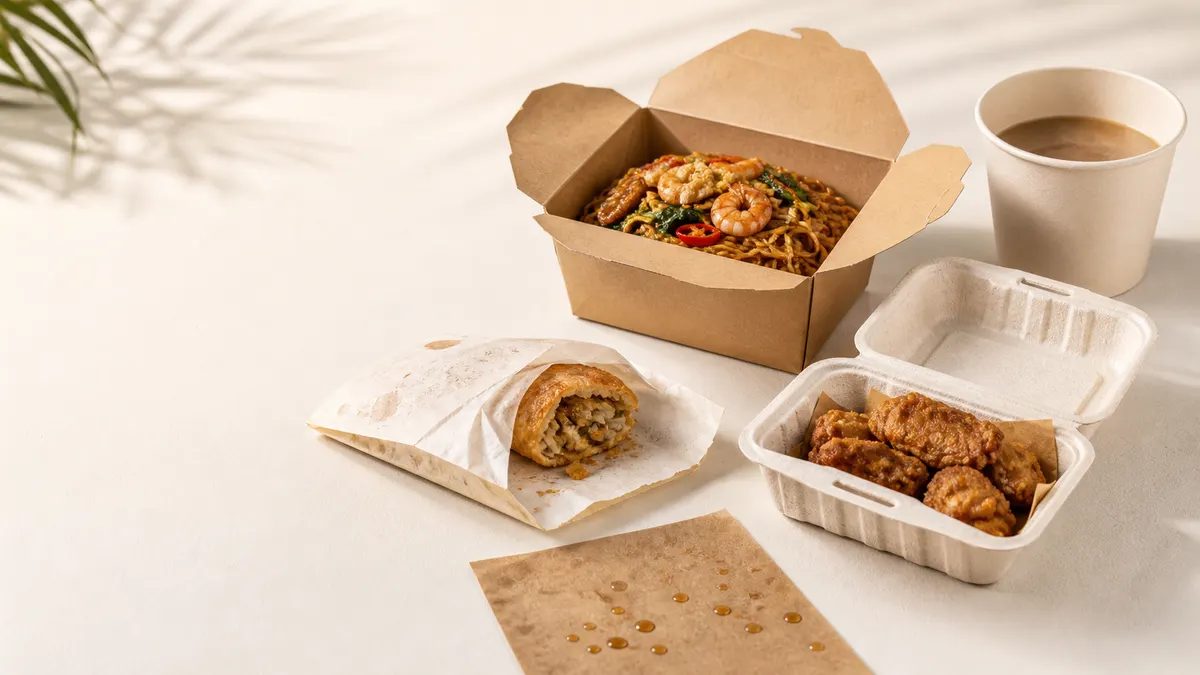
Choosing heat and grease resistant food packaging in Malaysia requires more than checking a container’s material or appearance. A package that holds a chilled salad may warp, leak, or transfer unwanted substances when filled with hot curry. Food businesses must match the complete package to the actual food, temperature, contact time, heating process, delivery conditions, and disposal route.
Choosing heat and grease resistant food packaging in Malaysia requires more than checking a container’s material or appearance. A package that holds a chilled salad may warp, leak, or transfer unwanted substances when filled with hot curry. Food businesses must match the complete package to the actual food, temperature, contact time, heating process, delivery conditions, and disposal route.
Key takeaway: Define the worst credible exposure first, document measurable pass criteria, and test the filled package under those conditions. A material specification is only the starting point; coatings, seams, closures, converting quality, and line settings can determine whether the finished pack succeeds.
Quick Answer: What Should You Check?
- Heat: Confirm the maximum filling, holding, reheating, or cooking temperature and duration.
- Grease: Test the highest-oil recipe for leakage, staining, softening, and barrier failure.
- Complete package: Assess coatings, inks, adhesives, seals, lids, vents, and exposed edges—not only the base material.
- Real handling: Simulate stacking, humid conditions, tilted motorcycle delivery, and delayed consumption.
- Evidence: Match food-contact, migration, and performance documentation to the finished construction and intended use.
- Disposal: Use recycling or composting claims only where a verified Malaysian collection and processing route exists.
A package is suitable only for the conditions it has been shown to survive.
1. Start With The Food And Its Real Exposure Conditions
Packaging selection should begin with the product rather than a shortlist of familiar containers. Migration and physical performance can change with food chemistry, temperature, contact duration, and the substances used throughout the package construction.
This is why heat and grease resistant packaging cannot be treated as universally suitable. A pack that performs well during 20 minutes of contact with a warm pastry may behave differently when it holds an oily, acidic curry for two hours or is reheated with the food inside.
Build An Exposure Profile
Record both normal operating conditions and the most severe conditions that could credibly occur. The profile should cover:
- the temperature at filling and the time required for the food to cool;
- the total period of direct food contact before consumption;
- refrigerated or frozen storage and any thawing stage;
- microwave reheating, conventional-oven use, pasteurisation, or retort processing;
- delivery time, orientation, stacking, and exposure to warm or humid surroundings;
- the highest realistic oil, fat, acid, salt, alcohol, and moisture levels; and
- credible misuse, such as delayed consumption or reheating beyond the normal instruction.
Food packaging temperature resistance is condition-specific. Evidence for chilled storage does not automatically demonstrate suitability for hot filling, microwave reheating, retorting, or conventional-oven use.
Consider a Malaysian SME selling fried snacks, curry-based meals, oily sambal, and butter-rich bakery products. The same paperboard box may remain rigid around a dry pastry but stain or soften around hot fried food. A tray suitable for curry at serving temperature may still deform during microwave reheating. Each recipe and process needs its own exposure profile.
2. Convert The Application Into A Packaging Requirement Sheet
A clear requirement sheet prevents suppliers, converters, laboratories, and co-packers from evaluating different assumptions. It also makes quotations and trial results easier to compare.
If the wider packaging brief is still undefined, start with a requirements-first food packaging selection guide before narrowing the options for heat and oil exposure.
Information To Record
- Product: fat content, visible free oil, water activity, acidity, salt, alcohol where relevant, particulates, aroma sensitivity, and expected recipe variation.
- Process: cold fill, warm fill, hot fill, pasteurisation, retort, microwave reheating, conventional-oven use, or no heating in the package.
- Time and temperature: normal and maximum values, contact duration, shelf life, cooling profile, and credible misuse conditions.
- Pack function: direct food contact, secondary containment, grease holdout, moisture or oxygen barrier, aroma retention, rigidity, venting, or tamper evidence.
- Operations: filling speed, seal-area contamination risk, stack height, storage humidity, transport distance, rider delivery, and manual handling.
- Required evidence: material specifications, intended food-contact use, migration or extraction results, seal operating window, heat-use restrictions, and finished-pack test results.
Compact Decision Table
| Requirement | Normal condition | Worst credible condition | Pass criterion | Evidence source | Responsible party |
|---|---|---|---|---|---|
| Fill temperature | 85°C | 90°C for five minutes | No distortion, opening, or barrier damage | Filled-pack trial and material specification | Food business and supplier |
| Grease contact | Moderately oily meal | Highest-oil approved recipe | No leakage or visible external staining during declared contact time | Real-food trial on production packs | Food business |
| Closure | Clean sealing flange | Controlled trace contamination challenge | Meets defined seal-strength and leak limits | Line validation and integrity test | Operations and quality teams |
| Delivery | Upright for 30 minutes | Tilted, stacked journey for 90 minutes | No leak, lid lift, collapse, or unsafe handling | Documented delivery simulation | Food business or test laboratory |
| Disposal claim | Intended sales area | All markets carrying the same printed instruction | Construction is accepted and processed through a verified route | Current collector or facility confirmation | Brand owner |
The values above are examples, not universal limits. Replace them with measured conditions from the actual product and process.
3. Compare Heat Resistant Packaging Materials By Behaviour
Material-family names hide important differences in grade, thickness, additives, coatings, seams, and manufacturing quality. Shortlist heat resistant packaging materials only after the exposure profile and pass criteria are defined.
Paper And Paperboard
Paperboard can provide stiffness, printability, and comfortable handling at moderate temperatures. Fibre can nevertheless absorb oil or moisture, swell, lose compression strength, and wick liquid through cut edges. Many food applications therefore depend on a coating, liner, or laminated barrier.
Moulded Fibre
Moulded-fibre trays and clamshells vary in density, surface finish, lid fit, coating, and forming consistency. Prolonged contact with hot, moist, or oily food may produce absorption, softening, staining, or dimensional change. Trials should include the lid and locking features, not only the base.
Plastic Tubs, Trays, Films, And Pouches
Resin identification alone does not establish maximum use temperature or food-contact suitability. Grade, wall thickness, orientation, additives, sealant layers, and manufacturing process influence stiffness, dimensional stability, barrier performance, and sealability.
A supplier should identify the maximum intended use and any limits on reheating, oven use, hot filling, or contact with fatty foods. The finished construction needs evidence matching the intended application.
Aluminium Formats
Aluminium trays can tolerate demanding thermal conditions, but the full system still requires assessment. Folds, seams, lidding, coatings, sharp edges, and compatibility with acidic or salty food can affect performance. Microwave use must follow the appliance, package, and food instructions established for the application.
Glass And Metal Containers
Glass and metal formats can support severe thermal processes when properly engineered. Their closures, internal coatings, corrosion resistance, thermal-shock limits, weight, breakage risk, and distribution impacts remain part of the decision.
Multi-material Structures
Laminates can combine stiffness, grease holdout, gas barrier, and sealability in a compact structure. Those benefits may make the package harder to separate, sort, or recover after use. Functional performance and end-of-life claims must therefore be evaluated separately.
4. Treat Barriers, Coatings, Inks, And Adhesives As Part Of The Package
The substrate alone does not determine whether grease resistant food packaging is suitable. Coatings, tie layers, adhesives, inks, colorants, additives, seams, and exposed edges can all influence food-contact safety and physical performance.
A barrier may initially hold back oil yet fail after folding, abrasion, or prolonged heat exposure. Pinholes, cracks at score lines, weak coat weight, and edge wicking can create local failure even when the flat centre panel performs well.
Questions To Ask About Grease Resistant Packaging Coatings
- What is the declared chemistry and coat weight?
- Is it intended for direct food contact with the specified fatty, acidic, aqueous, hot, or reheated food?
- What temperature range and maximum contact duration have been assessed?
- Does forming, scoring, folding, abrasion, or heat sealing damage the barrier?
- Do migration results cover the finished printed and converted construction?
- Is any repulpability or compostability claim supported for the complete package rather than the coating in isolation?
Printing and adhesive layers also need attention. They may transfer by contact between stacked surfaces, migrate through a substrate, or become exposed at seams and cut edges. Intended placement and manufacturing controls should be documented.
5. Verify Food Contact Packaging Compliance For Intended Use
Food contact packaging compliance should be assessed for the finished food-contact system under its intended conditions. A generic statement about resin, fibre, or coating chemistry does not automatically cover the converted package, every recipe, or every heating process.
What Food Packaging Migration Testing Does
Food packaging migration testing uses selected food simulants and time-temperature conditions to model contact with particular food categories. Fatty, acidic, aqueous, and alcoholic foods can require different simulants because they interact differently with packaging substances.
For Malaysian use, first obtain supplier documentation for the finished construction and intended food-contact conditions, then ask a competent laboratory to select an assessment matching the worst foreseeable food, contact time, temperature and process. As a US technical reference for dual-ovenable trays, FDA guidance recommends testing at the maximum intended conventional-oven cooking temperature and longest intended cooking time with food oil or a fatty-food simulant. EU plastics rules provide a separate framework with their own food simulants and time-temperature conditions. These foreign plastics references can inform a technical assessment; they do not establish Malaysian compliance or automatically apply to every packaging material.
As an international technical benchmark, European plastic food-contact rules pair simulants with food chemistry; 3% acetic acid is used for relevant acidic-food conditions. They also set overall migration limits of 60 mg per kilogram of food or 10 mg per square decimetre of contact material. Those limits should not be described as automatically governing every package sold in Malaysia.
The Malaysian Compliance Boundary
Malaysia’s baseline requirement prohibits food-contact articles that release or may release poisonous, harmful, or deteriorative substances into food. That makes the complete combination of food chemistry, heat, grease, coatings, adhesives, and processing conditions relevant.
Where rigid or semi-rigid PVC food packaging is being considered, specific limits apply: the packaging must not contain more than 1 mg/kg of vinyl chloride monomer, and food in that packaging must not contain more than 0.05 mg/kg. These figures are material-specific and should not be presented as general migration limits for other constructions.
International test frameworks can support a technical assessment but do not, by themselves, establish Malaysian compliance. Obtain current advice from a competent laboratory or regulatory specialist for the actual food, finished material, import status, manufacturing process, and claims.
6. Design Seals, Closures, Vents, And Headspace For Oily Products
Strong package walls cannot compensate for an uncontrolled closure. Food packaging seal integrity depends on compatible materials, seal geometry, equipment settings, cleanliness, pressure, time, and temperature.
Grease, sauce, moisture, crumbs, wrinkles, or voids in a sealing area can form channels or weak spots. A leak may pass through a material defect or through the interface between components intended to form the seal.
Flexible Packs
Validate a working seal window rather than relying on one nominal machine setting. Test the minimum and maximum acceptable temperature, pressure, and dwell time across normal line-speed and material variation.
Tubs And Trays
Assess flange flatness, lidding compatibility, seal uniformity, peel strength, burst behaviour, and performance after heating and cooling. A grease-resistant tray body does not solve contamination or distortion at the flange.
Hot-filled And Thermally Processed Containers
Hot fill packaging requirements include container and closure compatibility, fill temperature, cooling profile, headspace, internal pressure or vacuum response, seal performance, and line handling. These factors must be demonstrated together.
Residual air can expand during thermal processing and push against a closure. Inadequate headspace can deform a package or displace its closure. Intentional venting should therefore be distinguished from leakage, with a test defining what acceptable vent performance looks like.
7. Validate The Finished Pack Through Production And Delivery
Laboratory material data is only the first gate. Food packaging performance testing should cover the converted package, real filling line, representative product, distribution hazards, and the end of the declared contact period.
Run trials at normal and worst credible fill temperatures, grease levels, contact times, and fill weights. Inspect for external staining, leakage, delamination, warping, softening, coating cracks, odour transfer, lid lift, seal creep, and loss of stack strength.
Simulate Actual Malaysian Takeaway Handling
- warm and humid handling where it forms part of the real distribution route;
- motorcycle delivery with vibration, turns, braking, and tilted bags;
- stacked meals that place load on warm lids and bases;
- condensation after hot food is enclosed or chilled packs enter warmer air;
- delayed consumption at the maximum declared holding time; and
- drops, abrasion, and manual carrying at realistic fill weights.
Use measurable acceptance criteria. “Looks acceptable” is not enough; define permitted staining area, seal-strength range, leak threshold, maximum deformation, stack load, and test duration where relevant.
A Small Controlled Screening Trial For SMEs
- Select packages from three production lots.
- Fill them with the real food at the maximum declared temperature and weight.
- Hold them for the maximum declared contact time.
- Check a defined sample upright, tilted, and under the intended stack load.
- Run a documented delivery simulation of fixed time, route conditions, and orientation changes.
- Record pass or fail against leakage, staining, closure movement, deformation, odour, and stack-strength criteria.
This screen is deliberately simple and repeatable. It does not replace regulatory migration assessment, microbiological validation, formal seal-integrity testing, or process validation where those controls are required.
Repeat critical checks after changes to the supplier, grade, coat weight, ink, adhesive, tooling, line speed, sealing temperature, or recipe. Retain results and samples by production lot where the product risk justifies traceability.
8. Balance Material Reduction With Protection
Reducing material may lower resource use, but a lighter package is not an improvement if it leaks, collapses, causes food loss, or requires additional secondary packaging. The functional unit should be a safely delivered portion, not an empty container.
Compare a lightweight mono-material pack, coated-fibre pack, and higher-barrier multi-layer pack against the same requirements. Record the trade-offs rather than choosing on a single attribute.
- Material use: mass, thickness, renewable or recycled content, and manufacturing yield.
- Protection: seal reliability, stiffness, barrier life, heat retention, and food-waste risk.
- Operations: denesting, line speed, lidding, storage space, and reject rate.
- Distribution: transport cube, secondary packaging, breakage, and handling safety.
- Recovery: local acceptance, separability, residue, coatings, labels, and actual processing route.
The counterintuitive result may be that a slightly heavier package creates the lower-risk system because it prevents leakage, protects the meal, and removes the need for an extra bag. That conclusion still requires evidence; heavier is not automatically better either.
9. Match Disposal Claims To Malaysian Collection Realities
Sustainable food packaging Malaysia claims require two forms of proof: evidence about the complete material construction and evidence that a realistic local collection and processing route exists. Technical recyclability or compostability alone does not show that a used, food-contaminated package will be recovered.
Collection rules and processing access can vary by state, municipality, building, commercial collector, and waste contract. Check the destination where the package is actually sold instead of applying one instruction across Malaysia or wider Southeast Asia.
Questions For Recycling Claims
- Is the complete package accepted, including its liner, coating, lidding film, label, ink, and adhesive?
- Can consumers perform any required separation safely and consistently?
- Will food and grease residue prevent acceptance or reduce material value?
- Is the format collected, sorted, and processed in the intended locality?
- Has the collector or processor confirmed the route recently?
Questions For Compostability Claims
Industrial compostability, home compostability, and general biodegradability are different claims. Industrial compostability specifications address controlled, managed conditions; they do not establish performance in a small household compost system or prove that collection and industrial processing are available nearby.
Malaysia’s policy direction includes increasing biodegradable and compostable alternatives during 2026–2030. That objective is not proof that every material, collection service, or processing route is currently available nationwide.
The national approach also involves state governments and other stakeholders. Businesses should confirm current local rules and services before printing disposal instructions. A route verified in one Malaysian locality should not be generalised to Singapore, Indonesia, Thailand, Vietnam, the Philippines, or another market.
For a broader evaluation of collection, sorting, package design, and material demand, see what makes packaging recyclable in practice in Malaysia.
10. Use A Staged Selection And Evidence Checklist
MVP Option For A Limited Product Range
Select heat and grease resistant packaging already documented by the supplier for the defined food type and time-temperature profile. Confirm Malaysian food-contact suitability, then run filled-pack, seal, leak, stack, and delivery trials using conservative disposal wording tied to verified local services.
Final-product Option For Repeatable Scale
Create product-specific packaging specifications, obtain migration evidence for the finished construction, validate sealing windows and thermal processes, conduct formal distribution testing, and establish change controls. Verify environmental claims market by market across Malaysia and every additional Southeast Asian destination.
Supplier Evidence Checklist
- Exact material, grade, dimensions, thickness or basis weight, coating identity, and complete layer structure.
- Intended food types, grease exposure, contact duration, maximum and minimum temperatures, and heating restrictions.
- Applicable Malaysian documentation with supporting international frameworks clearly identified as such.
- Migration or extraction reports matched to relevant foods, simulants, time, temperature, and finished construction.
- Seal or closure compatibility, validated operating window, headspace requirements, and leak-test method.
- Finished-pack results covering filling, storage, stacking, delivery, reheating, and the declared contact period.
- Evidence for recycling, composting, bio-based content, or material-reduction claims and confirmation of the intended local route.
- A change-notification agreement covering substrate, coating, adhesive, ink, additive, manufacturing site, tooling, and process changes.
Frequently Asked Questions
Does “food Grade” Mean A Package Is Safe For Hot Oily Food?
No. The term does not, by itself, define the food type, temperature, duration, heating process, or complete construction assessed. Request evidence that matches the actual product and intended use.
Can A Microwave-safe Container Be Used For Hot Fill?
Not automatically. Microwave reheating and hot filling create different heating rates, pressure conditions, contact periods, and line stresses. The supplier’s intended-use statement and finished-pack validation should cover the specific process.
Is A Grease-resistant Paper Box Automatically Recyclable?
No. Recyclability depends on the complete construction, food contamination, local collection, sorting, mill acceptance, and material demand. A barrier that improves food performance may alter recovery compatibility.
Can Migration Data For A Raw Resin Cover The Finished Tray?
It may be supporting evidence, but it may not cover pigments, additives, coatings, inks, adhesives, conversion conditions, or the final wall thickness. Evidence should be matched to the finished food-contact system and its intended exposure.
When Should Testing Be Repeated?
Repeat affected checks after a meaningful change to the food, supplier, grade, formulation, coating, ink, adhesive, dimensions, tooling, line settings, heating process, or distribution route. Change control is part of maintaining suitability.
Choose One High-risk Product And Close The Evidence Gaps
Prepare one requirement sheet for the product with the highest temperature, grease load, contact time, or closure risk. Compare two or three documented constructions against identical acceptance criteria, then ask the selected supplier or laboratory to resolve missing evidence before commercial use.
The practical objective is not to find a material with the strongest general claim. It is to approve a complete package for a defined product, process, journey, and disposal message—and to know when a change requires reassessment.
References
- US FDA — Preparation of Premarket Submissions for Food Contact Substances: Chemistry Recommendations
- European Commission — Food Contact Materials Legislation
- Malaysia Ministry of Health, Food Safety and Quality Programme — Microplastics and Food Packaging Regulations
- US FDA — Food Packaging and Other Substances That Come into Contact with Food
- US FDA Bacteriological Analytical Manual — Examination of Containers for Integrity