Eco Pack Friend Editorial Team
Glass Vs Aluminium Packaging In Malaysia: Weight, Safety, Recycling And Reuse
Glass vs aluminium packaging is not a contest with one universal winner. This practical guide compares glass bottles and aluminium cans for Malaysian brands, contract packers and SMEs, covering product protection, food-contact safety, transport weight, breakage, recycled content, local recycling and refill systems.
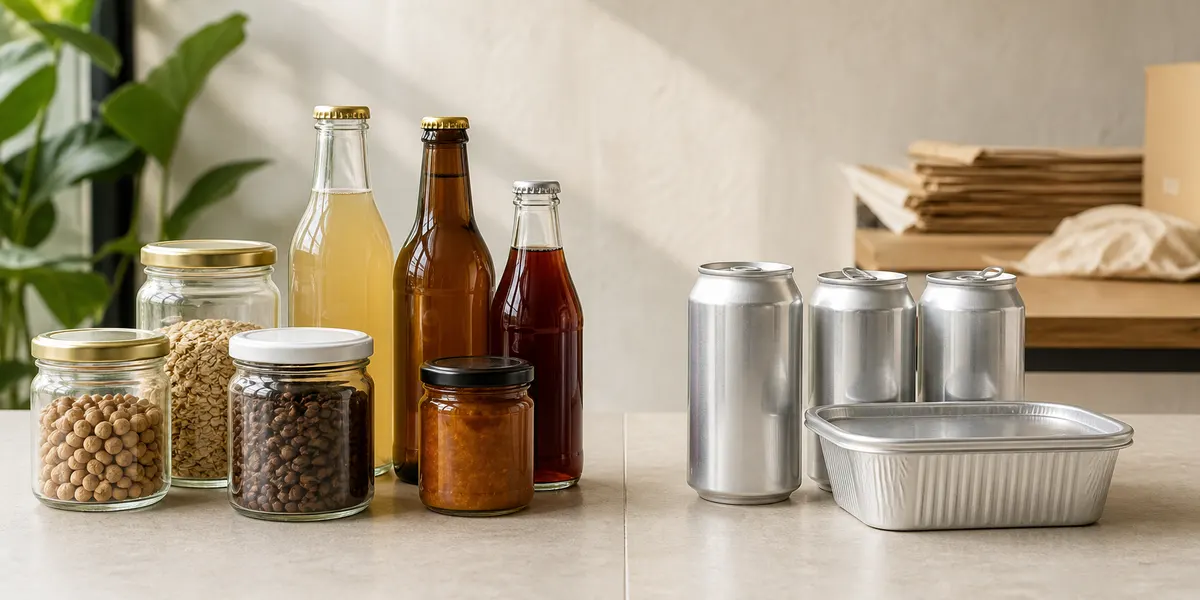
Glass vs aluminium packaging is not a contest with one universal winner. This practical guide compares glass bottles and aluminium cans for Malaysian brands, contract packers and SMEs, covering product protection, food-contact safety, transport weight, breakage, recycled content, local recycling and refill systems.
The lightest container can lose its advantage if it needs more secondary packaging or suffers frequent damage. A refillable bottle can also underperform if few bottles return. The important question is not which material sounds more sustainable, but which complete packaging system protects the product with the least credible burden under actual operating conditions.
Key takeaway: Aluminium is generally lighter, opaque and resistant to shattering. Glass is chemically inert, provides product visibility and can suit a well-managed refill system. Either can provide strong hermetic protection, but caps, seams, liners, coatings and handling damage often decide whether the package performs as intended.
1. Neither Material Is Universally Better
The central glass versus aluminium packaging trade-offs become clearer when the package is treated as a working system. Material identity alone does not reveal shelf life, transport losses, recycled content or the likelihood of recovery after use.
A tightly closed glass bottle and a properly formed rigid metal can can both prevent the passage of gases, vapours and microorganisms. Neither remains hermetic if a cap is applied incorrectly, a sealing surface is damaged, a can seam is defective or the container develops a leak.
| Decision factor | Glass | Aluminium | Evidence to verify |
|---|---|---|---|
| Gas and moisture barrier | Strong when the bottle and closure remain intact | Strong when the body, seams and coating remain intact | Leak, seal-integrity and shelf-life results |
| Light protection | Clear glass admits light; colour, labels or cartons can reduce exposure | Opaque and an effective light barrier | Product light-sensitivity testing |
| Package mass | Usually substantially heavier for a comparable capacity | Usually lighter | Filled mass and units per pallet |
| Physical damage | Can fracture under impact, pressure or thermal shock | Can dent, buckle, develop pinholes or suffer seam damage | Route-specific damage and leakage rates |
| Food-contact system | Inert glass body, plus closure liners, seals, inks and adhesives | Metal body commonly protected by an internal coating | Supplier declarations and compatibility evidence |
| Recycled inputs | Cullet can reduce furnace energy, subject to colour and quality | Recycled aluminium can greatly reduce production energy | Supplier-specific post-consumer content |
| Recovery | Acceptance may be constrained by mass, breakage, colour and distance | Scrap value can support collection, but access is not universal | Customer-area collector and processor confirmation |
| Reuse potential | Strong where durable bottles complete many short return cycles | Usually designed for material recycling rather than refilling | Achieved trips, return rate and replacement rate |
A package is not sustainable because of what it is made from; its result depends on what it protects, how it travels and what happens after use.
2. Product Protection Starts With The Complete Package
Glass And Aluminium Barrier Performance Depends On Package Integrity
The container body is only one part of the barrier. Glass itself is impermeable, while an intact aluminium body provides an effective barrier to gases, moisture and light. Actual shelf life still depends on components and manufacturing details that join or close the package.
For glass, relevant variables include the bottle finish, sealing surface, cap torque, liner, seal and resistance to pressure. For a can, they include seam formation, body integrity, internal coating coverage and resistance to dents or pinholes. Damage during filling, pasteurisation, warehousing or transport can undermine either format.
Brands should validate filled packages rather than relying on a resin, metal or glass description. Suitable checks may include leak detection, closure or seam inspection, pressure testing, thermal cycling and shelf-life testing under expected storage conditions.
Light, Moisture And Oxygen Affect Products Differently
Aluminium can be useful for products that deteriorate under light because the container is opaque. Clear glass allows consumers to see the product, but that benefit can increase exposure for light-sensitive formulations. Amber or other coloured glass, full-body sleeves, labels and secondary cartons can reduce exposure, although each addition affects cost and recovery.
A coffee drink may need oxygen and light control to preserve flavour. Edible oils can oxidise or develop off-notes when exposed to unsuitable conditions. Sauces may be less sensitive to light but create different demands through acidity, salt, hot filling or pasteurisation.
No barrier comparison is complete until the product formulation, headspace, filling process, closure and intended shelf life are tested together.
3. Food-contact Suitability Uses Different Engineering Controls
Glass Body And Closure Components
Glass is chemically inert in typical food-packaging applications. Its principal body-related limitations are mechanical: impact, internal pressure and rapid temperature changes can cause fracture. Bottle design, wall distribution and handling conditions therefore matter.
The inertness of the bottle does not make the complete package automatically suitable. A metal cap may use a liner or coating, while seals, inks and adhesives may also form part of the food-contact or foreseeable migration assessment. Suppliers should identify every component relevant to the intended use.
Aluminium Body And Coating System
Aluminium packaging internal liners are commonly used to limit corrosion and metal migration. The coating becomes an important food-contact surface, so its compatibility must be assessed for the actual formulation and process.
Acidity, salt, alcohol, fat, filling temperature, heat processing and intended shelf life can affect coating selection. A coating suitable for one beverage is not automatically suitable for an acidic sauce or another product with different processing conditions.
Malaysian businesses should obtain evidence that applies to the intended local market and to every export destination. Information from another jurisdiction can help explain the function of a coating, but it does not replace applicable Malaysian requirements or destination-market checks.
Supplier Information An SME Should Request
- A declaration identifying the container and its intended food-contact uses.
- The bottle-finish and closure specification, or the can-body and seam specification.
- Information about cap liners, can coatings, seals, inks and relevant adhesives.
- Compatibility limits for acidity, alcohol, fat, salt, pressure and temperature.
- Filling, closing, pasteurisation, retort, cooling and storage limits where applicable.
- Migration, corrosion, leak and shelf-life evidence relevant to the filled product.
- Traceability details that connect supplied batches to the declared specification.
4. Glass Vs Aluminium Packaging Weight And Transport
Package Mass Changes The Delivery System
Glass is typically much heavier than an aluminium can holding a similar volume. That difference can affect vehicle payload, fuel demand, manual handling, pallet efficiency and shipping cost. Its importance grows on long routes, but it should be calculated rather than assumed.
The useful comparison unit is not an empty container. It is the quantity of saleable product delivered without leakage or damage, including containers, closures, trays, dividers, cartons, pallets, rejected units and any return journey.
For a Malaysian brand, the result can change between a short Klang Valley delivery route and distribution involving East Malaysia or regional export shipping. Urban last-mile delivery may place more emphasis on manual handling and repeated loading. Sea freight may increase the importance of pallet density, vibration, humidity exposure and time in transit.
Breakage And Denting Create Different Risks
Glass can fracture after impact, internal pressure or thermal shock. Apart from the lost unit, fragments can create worker-safety risks and contaminate neighbouring stock. A single breakage event may therefore affect more product than the broken bottle alone.
Aluminium avoids shattered fragments but is not damage-proof. A can may dent, buckle or suffer seam and pinhole damage under poor compression, vibration or handling. Some deformation is cosmetic; other damage can cause leakage or compromise package integrity.
Secondary packaging and pallet design should reflect these failure modes. Variables include divider strength, tray design, pallet pattern, stacking height, stretch wrapping, warehouse temperature and the number of handling transfers.
Transport Evidence To Compare
- Filled mass per unit, case and pallet.
- Saleable product volume or mass per pallet position.
- Damage, rejection and leakage rates from comparable routes.
- Compression, drop, vibration and thermal-cycle results where relevant.
- The cartons, dividers, trays, edge protection and shrink film required.
- Container and product losses during filling, warehousing and delivery.
- Return-trip distance and vehicle utilisation if refillable bottles are proposed.
5. Glass Vs Aluminium Packaging Sustainability Depends On The Inputs
Comparisons often place a primary material figure for one format beside a recycled-material figure for another. That is not a fair boundary. Factory technology, recycled content, electricity supply, container mass, filling losses and transport must be aligned before a conclusion is drawn.
Glass Melting And Cullet
Glass production melts raw materials and cullet at approximately 1,500°C. Manufacturing emissions arise from furnace energy and from the decomposition of carbonate raw materials.
Using more suitable cullet can lower the energy needed for primary processing. One analysis estimates a 2.5% to 3.0% reduction in primary-processing energy for every 10-percentage-point increase in cullet. The realised result still depends on furnace technology, cullet quality, colour separation and contamination.
A supplier’s total cullet percentage should not automatically be described as Malaysian post-consumer recycled content. It may include factory-recovered glass, pre-consumer material, imported cullet or a mixture. Each category answers a different question.
Primary And Recycled Aluminium
Primary aluminium production is energy intensive. Producing cans from recycled aluminium can use about 95% less energy than producing aluminium from bauxite, which makes recovered material and verified recycled content important to the manufacturing comparison.
That energy difference does not disclose the recycled content of a particular can. It also does not prove that a discarded can will be collected or returned to can production. Supplier-specific evidence and local recovery conditions are still required.
Questions That Prevent Misleading Comparisons
- What is the verified recycled content of the supplied container?
- How much is post-consumer, pre-consumer or factory-recovered material?
- Does the assessment include forming, coatings, closures and decoration?
- Are secondary packaging and product losses inside the boundary?
- Which factory, electricity mix, filling process and transport distances are assumed?
- Are the functional unit and shelf-life performance equivalent?
For a broader way to compare boundaries and trade-offs, use a practical life-cycle assessment of packaging rather than comparing isolated headline figures.
6. Glass Vs Aluminium Packaging Recycling Requires More Than One Percentage
Collection, Recycling And Closed-loop Return Are Different
- Collection rate
- The share of discarded material captured by a collection system.
- Recycling rate
- The share reported as entering or completing recycling, depending on the study boundary.
- Process yield
- The usable material remaining after sorting and processing losses.
- Recycled content
- The recycled material incorporated into a new package.
- Closed-loop recovery
- Material returned to the same packaging application rather than used in another product.
A 2025 global study commissioned by industry groups estimated that 75.6% of aluminium beverage cans were collected and 74.8% were recycled. Its corresponding estimates for glass bottles were 44.5% collected and 41.9% recycled. These global figures are not reliable Malaysian aluminium benchmarks. [7]
The same dataset estimated losses between collection and recycling of 1.0% for aluminium cans and 5.8% for glass bottles. However, the aluminium estimate excluded contamination, delacquering and remelting losses. It therefore cannot be treated as a complete comparison of usable process yield.
Another result exposes a common circularity mistake: 71% of aluminium cans in the reported 2019 global flows were recycled, but only 33% returned to can production. The remainder moved into other aluminium uses. Material recycling and can-to-can circularity are not interchangeable claims. [8]
Where Material Can Be Lost Or Redirected
- Placed out: The user separates or discards the container.
- Captured: A municipal or commercial system collects it.
- Sorted: Equipment and workers identify an accepted material stream.
- Processed: Contamination, coatings, colour or unsuitable pieces are removed.
- Converted: Usable secondary material is produced.
- Remanufactured: The material enters a new container or another application.
Losses can occur at every stage. A technically recyclable package may still have little chance of recovery if it is not accepted, sorted or connected to a viable end market. The distinction is explored further in this guide to what makes packaging recyclable in practice.
7. Glass And Aluminium Recycling In Malaysia Varies By Location
Historical Evidence Identifies Persistent Questions
A Malaysian government and development-agency study using 2004-era data described approximately 30% cullet in Malaysian glass production. Only about 10 percentage points were attributed to domestic post-use glass. These figures provide historical context, not a current recycled-content or collection benchmark. [9]
The study associated glass recovery constraints with low scrap value, weight, breakage and distance from manufacturers, especially in rural areas and Sabah and Sarawak. It described aluminium-can recovery as comparatively market-driven because aluminium had a higher scrap value. Current conditions must be verified rather than inferred from that historical relationship.
Local Programmes Demonstrate Uneven Access
A 2024 municipal event in Iskandar Puteri offered RM3.00 per kilogram for aluminium and explicitly did not accept glass. [10] A 2026 municipal programme in Melaka accepted glass bottles at RM0.10 per kilogram. [11]
These are individual local programme examples. They are not national acceptance rules, permanent services or universal market prices, and they should not be extrapolated to Sabah, Sarawak or wider Southeast Asia.
The surprising lesson is that a material’s theoretical recyclability may matter less than the collector operating where the empty package actually appears.
Verification Steps For A Malaysian Business
- Ask the actual collector which formats, colours, coatings and contamination levels are accepted.
- Confirm pickup minimums, storage requirements, transport distance and price basis.
- Identify the downstream sorting or processing facility where possible.
- Check customer locations, not only the factory or filling location.
- Separate household, commercial, event-based and deposit-return routes.
- Recheck periodically because programmes, buyers and commodity values can change.
8. Refillable Glass Vs Single-use Aluminium Is A System Comparison
Glass has credible refill potential when bottles are engineered for repeated filling, washing, inspection and expected pressure conditions. Reuse can change the result, but the word “refillable” alone is not evidence of environmental improvement.
Conditions That Can Favour Refillable Glass
- A high return rate and enough completed trips per bottle.
- Short, dense reverse-logistics routes with good vehicle utilisation.
- Standardised or pooled formats that reduce sorting complexity.
- Controlled handling, efficient washing and appropriate water management.
- Reliable inspection and rejection procedures before refilling.
- Sufficient volume to operate the return system efficiently.
Conditions That Weaken The Reuse Case
- Low return rates or high bottle losses.
- Long return distances and one-way distribution routes.
- Many proprietary formats with little coordination among participants.
- Frequent breakage or rejection that requires replacement bottles.
- Inefficient washing or poorly utilised collection vehicles.
Conditional modelling of returnable packaging shows why achieved cycles matter: low-return, poorly coordinated systems require more replacement bottles and can perform substantially worse than the ideal scenario. No single break-even trip count applies to every bottle, product or route.
Evidence To Publish With A Reuse Claim
- Average achieved trips per bottle and how trips are counted.
- Return, loss, breakage and inspection-rejection rates by route.
- Transport distance and vehicle loading in both directions.
- Washing conditions, water and energy demand, and wastewater handling.
- Replacement rate and the single-use baseline used for comparison.
9. How To Choose Between Glass And Aluminium Packaging
Step 1: Protect The Product
Define sensitivity to light, oxygen, moisture, flavour interaction, internal pressure and temperature. Validate the complete glass bottle vs aluminium can system, including cap or seam, liner, coating, filling process and intended shelf life.
Step 2: Model The Actual Route
Compare filled weight, pallet count, secondary packaging and expected breakage, denting or leakage. Include interstate distribution, East Malaysia shipping or Southeast Asian exports only when they form part of the real sales network.
Step 3: Verify Manufacturing Claims
Request supplier-specific recycled-content evidence and clarify whether the percentage is post-consumer. Compare assessments only when their functional units and lifecycle boundaries are sufficiently aligned.
Step 4: Check Recovery Where Customers Live
Document which local collectors accept the format and whether it reaches a suitable processor. Record “technically recyclable” and “routinely collected” as separate findings.
Step 5: Test Reuse Only When An Operating Model Exists
Run a limited return trial and measure achieved trips, return rate, breakage, washing demand and logistics. Do not promise better performance before the measured system reaches the conditions assumed by the comparison.
| Requirement | Glass evidence | Aluminium evidence | Malaysian route evidence | Unresolved assumption | Decision owner |
|---|---|---|---|---|---|
| Product protection | Closure and shelf-life results | Seam, coating and shelf-life results | Storage conditions | Worst-case exposure | Technical or quality lead |
| Distribution | Mass and breakage rate | Mass and damage rate | Actual route data | Future route changes | Operations lead |
| Manufacturing | Verified cullet content | Verified recycled content | Supplier location | Comparable boundaries | Procurement lead |
| Recovery | Collector acceptance | Collector acceptance | Customer-area access | Downstream destination | Sustainability lead |
| Reuse | Trial return cycles | Single-use baseline | Reverse route | Scale-up return rate | Commercial lead |
10. Frequently Asked Questions About Glass Vs Aluminium Packaging
Is Aluminium Always Better Because It Is Lighter?
No. Lower container mass can reduce transport burdens, but the comparison should include secondary packaging, pallet efficiency, damage, product loss and route conditions. Supplier-specific recycled content and production boundaries can also change the result.
Is Glass Always Better Because It Can Be Reused?
No. Reuse requires a bottle designed for repeated cycles and an operating system that achieves high returns, controlled washing and efficient reverse logistics. A bottle that is technically refillable but rarely returned does not demonstrate a successful reuse outcome.
Can Both Formats Protect Oxygen-sensitive Products?
Yes, if the complete package remains hermetic and is compatible with the product. Closure application, seams, coatings, headspace, filling conditions and damage can determine actual performance.
Does Recycled Aluminium Automatically Return To New Cans?
No. Recycled aluminium may enter another aluminium application. A recycling-rate claim does not by itself establish can-to-can recovery or the recycled content of the next package.
Are Glass Bottles And Aluminium Cans Recyclable Throughout Malaysia?
Technical recyclability does not guarantee routine collection. Acceptance can vary by municipality, commercial collector, programme, container condition and downstream demand. Businesses should verify conditions in the places where customers are likely to discard the package.
11. Choose With Product And Route Evidence
Glass vs aluminium packaging cannot be decided from material identity alone. Aluminium’s typical advantages are low mass, opacity, resistance to shattering and value in established scrap markets. Glass offers chemical inertness, product visibility and credible repeat-use potential when a high-return, short-route system operates effectively.
Closures, seams, liners, coatings, recycled content, collection access, processing losses and real transport damage can reverse a headline comparison. Global figures can provide context, but Malaysian evidence should be labelled when it is historical, local-programme-specific or unavailable.
The practical next step is to compare supplier specifications in one evidence worksheet, test the filled packages and map collection or return conditions along the actual Malaysian sales routes before selecting a format or publishing an environmental claim.
References
- FAO — Fruit and Vegetable Processing: Packaging Materials
- International Aluminium Institute — Protective Packaging
- U.S. FDA — Questions and Answers on BPA Use in Food Contact Applications
- UK Government — Unlocking Resource Efficiency: Phase 2 Glass
- Glass Structures & Engineering — Mapping the Flat Glass Value Chain
- U.S. Energy Information Administration — Recycling and Energy
- Eunomia: Global Beverage Container Recycling Dataset, 2025 Results
- International Aluminium Institute: Can-to-Can Recycling factsheet
- JICA and Malaysian National Solid Waste Management Department: The Study on National Waste Minimisation in Malaysia, Supporting Report 1
- Majlis Bandaraya Iskandar Puteri: Drive To Save @ MBIP, April 2024 programme notice
- Majlis Bandaraya Melaka Bersejarah: AKKB Ramadan 2026 programme notice
- Ministry of Health Malaysia: Food Regulations 1985