Eco Pack Friend Editorial Team
Reading internal vs external box dimensions: will your product fit?
Learn which measurements confirm product fit in an assembled box, how to distinguish internal, external and dieline dimensions, and what to agree with a supplier. A hypothetical café tray calculation separates clearance, board thickness and tolerances, followed by an assembled-sample checklist and guidance on broader performance checks.
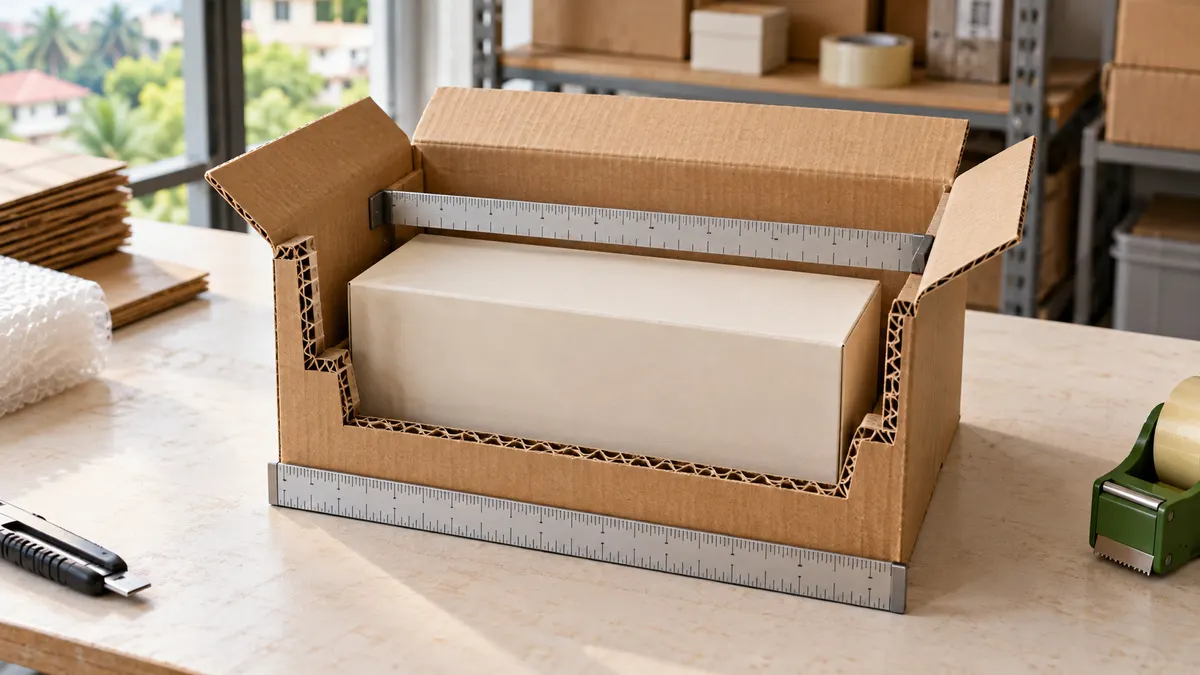
A sealed snack tray catches on the takeaway box at a Malaysian café counter, even though its smaller base seems to match the quoted size. For small-business owners and packaging coordinators, understanding internal vs external box dimensions starts with three checks: the complete packed product, the assembled cavity and the opening through which the product must pass. A flat panel measurement or three-number quotation cannot confirm all three.
Key takeaway: Specify the minimum usable internal length, width and height with inserts and closures in place, then check that the actual product passes through the opening. Agree a separate maximum packed external size when the box must fit a delivery bag, shelf or master carton.
A product can fit inside a box yet fail to enter it. Your supplier specification needs to account for both the opening and the space inside the assembled box.
Start with the packed product and the usable cavity
Measure the complete item in its intended loading orientation, including its widest lid rim, wrapping, tray and projections. For the café snack tray, measuring only the base misses the overhanging sealed lid. Count an insert either within the packed assembly's measurements or as space occupied inside the box; do not count it twice.
When deciding how to measure internal box dimensions, start between the assembled inner faces and check the narrowest relevant spans. Establish the clear height beneath the closed lid, allowing for inward-projecting tabs and folded layers. Then check the loading opening: a tuck tab or restricted entrance can catch a product that would otherwise fit the main cavity.
| Measurement | What it describes | What it helps decide |
|---|---|---|
| Internal dimensions | Space between assembled inner surfaces; local obstructions can reduce usable space. | Whether the complete packed product fits with the required clearance. |
| External dimensions | Overall size of the closed, fully packed box, including bulges. | Fit in delivery bags, shelves and master cartons, and compliance with courier size limits. |
| Panel or crease-to-crease dimensions | Distances between specified reference lines on the flat blank. | How the structure is laid out before folding. |
Malaysian carton supplier Quinocycle describes the L × W × H measurements in its sizing guide as internal dimensions. That is the supplier's stated convention; confirm it for the box you are ordering. Quinocycle Malaysia — How to Choose the Right Carton Box Size for Your Business.
For shipping measurements, DHL instructs readers to measure a closed, fully packed box and use the widest outermost points where it bulges. Keep that external measurement separate from the space available for the product. DHL Express — How to Measure Box Size for Shipping.
Confirm what the supplier means by L × W × H
Resolve the box dimension order length width height before comparing quotations. The FEFCO corrugated-case convention uses internal dimensions in millimetres: length normally follows the longer dimension at the opening, width the shorter, and height runs from the opening to the base. Some designs can have W greater than L, so do not assign axes simply by sorting the numbers. FEFCO — International Corrugated Board Case Code, 12th Edition.
This corrugated-case convention does not guarantee that every folding-carton or takeaway-box supplier uses the same order. Request an annotated assembled view with the opening, loading direction and L/W/H arrows marked.
Ask the supplier to identify the units and whether each dimension is internal, external or measured between crease centres. Also distinguish a nominal internal size from a guaranteed minimum usable cavity. These are different commitments when production tolerances and closure intrusions matter.
For this drawing revision, are these measurements in mm and in internal L × W × H order? Please mark the opening and confirm the minimum usable space after assembly and closure.
A drawing showing dimensions and tolerances can resolve questions that an artwork template leaves open. 3M distinguishes these functions in its Global Dieline Requirements.
Read the dieline from flat blank to assembled box
Learning how to read a box dieline starts with identifying what the file specifies. A production dieline maps structural features and artwork placement; a dimensional drawing specifies dimensions and tolerances. Request both if the supplied file does not resolve fit.
Read the legend and stated scale before interpreting dieline cut lines and crease lines. For its own packaging workflow, 3M requires dielines at 100% scale with a line-type legend and labelled views where applicable. Do not rely solely on colour or measure a screenshot as though it were a full-size technical drawing. 3M Corporate Packaging Engineering — Global Dieline Requirements.
CUT EDGE | glue flap G | side panel W | front panel L | side panel W | back panel L | CUT EDGE
Read this as a strip of adjoining panels. The separators between the glue flap and panels, and between neighbouring panels, represent vertical creases; the two outer boundaries are cut edges. Horizontal creases, omitted here, separate the body panels from the top and bottom closure flaps.
L and W identify each panel's role in the assembled box. They do not promise that its raw flat width equals the final clear internal span. Layouts and seam positions vary, so terminal-panel measurements must follow the drawing's indicated references rather than an assumed pair of creases.
| Feature | What to read | Fit implication |
|---|---|---|
| Cut lines | The blank perimeter, slots, windows and other cuts through the board. | The overall cut-to-cut blank size is not the assembled cavity size. |
| Crease lines | The intended fold positions. | Use the drawing's specified measurement references. |
| Body panels | Panel widths and body height between the indicated references. | Construction affects how flat measurements become usable internal spans. |
| Closure flaps | Material beyond the upper and lower body creases. | Flaps enlarge the blank without increasing body height; folded layers can occupy internal space. |
| Glue flap | The overlapping material forming the bonded joint. | The joint adds material, not equivalent internal length. |
| Artwork bleed | Artwork extending beyond a cut line. | Bleed adds no physical usable space. |
FEFCO specifies measuring the flat blank from crease centres while accounting for material thickness, under reference conditions of 23°C and 50% relative humidity. To interpret crease-to-crease box measurements as clear internal dimensions, you need to account for the construction. FEFCO — Case Code, Styles and the Manufacturer’s Joint.
Die Cut Templates explains cuts, folds, glue tabs and bleed in its Anatomy of a Packaging Dieline. Applying those definitions to this hypothetical layout, a 15 mm glue flap on a box dieline overlaps the adjoining panel; it does not create another 15 mm of internal length. An inward overlap creates a local extra layer, which can matter beside a closely fitting tray.
Work through a café tray in millimetres
Hypothetical teaching example: All dimensions and allowances below are editorial calculations, not sourced product data, a recommended clearance standard or a supplier specification.
Suppose the complete sealed tray measures 120 × 80 × 40 mm at its widest points. For this example only, select 2 mm clearance at each opposing face. This keeps box clearance and board thickness separate from the adjustments required to manufacture and assemble the box.
| Item | Value | Meaning |
|---|---|---|
| Complete sealed tray | 120 × 80 × 40 mm | Maximum product envelope, including the widest lid rim. |
| Selected clearance | 2 mm at each opposing face | 4 mm added to each overall product dimension. |
| Required minimum clear cavity | 124 × 84 × 44 mm | Space needed to preserve the selected clearance. |
| Assumed board caliper | 0.5 mm | Thickness of one board layer. |
| Simplified external estimate | 125 × 85 × 45 mm | Idealised cavity plus one 0.5 mm wall at each opposing face. |
The cavity calculation is:
- Length: 120 + 2 + 2 = 124 mm.
- Width: 80 + 2 + 2 = 84 mm.
- Height: 40 + 2 + 2 = 44 mm.
The height assumption includes 2 mm below and 2 mm above the tray. A tray resting directly on the base would have a different allocation of space. Specify support and headspace deliberately, including any support material in the fit assessment.
For the simplified external estimate, 124 + 0.5 + 0.5 = 125 mm; the same operation gives 85 mm and 45 mm. This assumes ideal single-layer walls on every face. Real base and lid overlaps, folds, tuck tabs and seams can change both the external size and local usable space.
When comparing internal vs external box dimensions, keep these three concepts distinct:
- Clearance is the space allocated around the packed product.
- Caliper is the board's material thickness.
- Construction allowances are design adjustments for folds, scores, tucks and joints.
CIP4 identifies inside loss and outside gain as dimensional values used in box design and notes that their sum is not necessarily equal to material thickness. Adding or subtracting twice the caliper is therefore only a simplified estimate, not a universal conversion between panel, internal and external measurements. CIP4 — JDF Specification 1.8, Section 8.90.2.1.
The selected 2 mm clearance says nothing about cushioning, impact protection or suitability for e-commerce shipping.
Turn the fit requirement into a supplier specification
Box dimension tolerances can leave less space than the calculation requires. Continue the hypothetical example: ordering a nominal internal size of 124 × 84 × 44 mm with an allowed −1 mm deviation on each dimension could produce 123 × 83 × 43 mm.
The tray may still fit, but it would have less than the selected clearance. Each axis now has 3 mm total clearance instead of 4 mm; if centred, the tray would have 1.5 mm at each opposing face. "Fits inside" and "meets the agreed clearance" are different acceptance results.
To preserve that clearance, specify 124 × 84 × 44 mm as the required minimum usable cavity. Ask the supplier to determine suitable nominal dimensions, construction allowances and the production dieline. The tolerance scenario is hypothetical; 3M's Dimensional Drawing Definition establishes the role of dimensions and tolerances in the drawing, not a universal tolerance value.
Record these points against the current drawing revision:
- Board specification and caliper.
- Dimension order, units, orientation and measurement reference surfaces.
- Nominal dimensions, tolerance limits and minimum usable cavity.
- How the design accounts for seams, inserts and closed-lid obstructions.
- A separate maximum packed external size where delivery-bag or master-carton fit matters.
A minimum cavity requirement alone does not establish the maximum external size. Both belong in the brief when both affect the purchase.
Packed tray: 120 × 80 × 40 mm. Required minimum usable cavity: 124 × 84 × 44 mm in the agreed orientation, with closure parts and inserts in place. Please confirm nominal dimensions, tolerances, board specification and the estimated packed external size on the labelled drawing.
Use an assembled box fit checklist
Bring the drawing and the actual packed product to the sample review. Record measured values against agreed limits, rather than signing off only that the tray went in.
- Assemble a sample in the specified board with all intended inserts, tabs and closures. Record the drawing revision.
- Measure the narrowest relevant internal spans and clear height beneath the closed lid, including local seam and flap intrusions.
- Load the actual packed product through the intended opening in the intended orientation.
- Inspect the glue seam, tucked tabs and overlapping flaps for catching, pressure or loss of clearance.
- Close and reopen without forcing the box, crushing the product or creating bulges. Check the agreed clearance.
- Record the closed, fully packed external dimensions at the widest points and compare them with the agreed limits and tolerances.
PackMojo describes structural samples as tools for checking size and structure, while noting that its sample-machine creases and assembly behaviour can differ from production. Use a production-representative sample for final fit approval. PackMojo — Structural Samples and Their Limitations.
One passing sample demonstrates that sample's fit. It does not establish dimensional consistency across a production run; agree with the supplier how to check and record production measurements.
Keep Malaysian handling conditions in view
A fit check on an air-conditioned office table does not establish performance in a humid back-room storeroom or in takeaway stacks handled during monsoon weather. ISTA's guidance identifies high humidity as a condition that can reduce corrugated-container strength, with board moisture content being the direct influence. Recheck shape, closure engagement and usable space under representative storage and handling conditions. ISTA — Guidelines for Selecting and Using Test Procedures and Projects.
Condensation from an iced drink carried beside the carton, sauce leaking from a container, and heat during a parked-car delivery stop require separate performance checks. For material decisions, use the guide to choosing packaging for heat, grease, moisture and delivery. A successful insertion check cannot establish resistance to those exposures or prove stacking strength.
DHL's packing guide directs shippers to consider contents' weight and fragility, suitable cushioning and prevention of movement. A café carryout carton therefore needs a separate assessment before becoming an e-commerce shipping pack. Consult DHL Express — An Essential Packing Guide for broader packing and protection considerations.
To plan the wider assessment, use the requirements-first guide to checking packaging under real storage and delivery conditions. ISTA’s test procedure guidance can inform transport-validation planning; reading it or passing a dimensional fit check does not constitute certification.
Common fit questions
Can I use the longest number as the length?
Use the supplier's labelled axes and opening orientation. FEFCO notes that some designs have width greater than length, so sorting the numbers can assign them to the wrong sides.
Is a 124 mm panel enough for a 124 mm clear cavity?
That panel value alone cannot confirm it. Establish the reference lines, board specification and construction adjustments, then check the assembled span at the narrowest relevant point.
Does easy closure prove the box is correctly sized?
Easy closure is one check. Also confirm entry through the opening, clearance beside seams and tabs, usable height with the lid closed, and the packed external dimensions.
Approve the measurements that control fit
When specifying internal vs external box dimensions for an order, confirm the complete product envelope, minimum usable cavity, loading opening, closed-lid clearance and maximum packed external footprint. Have the supplier identify the measurement convention and tolerances on the current drawing, then check the assembled sample.
Before approving the order, send the supplier the packed product measurements and required minimum cavity. Request a labelled assembled view and a production-representative fit sample, and record whether each agreed dimensional limit is met.
- Box dimensions
- Dielines
- Packaging tolerances
- Packaging samples
- Takeaway packaging
- Supplier specifications