
 Eve Mayo
Kraft Paper Packaging: Benefits, Limits, Best Uses, and Buyer Checklist
Kraft paper packaging guide for buyers: compare benefits, limits, best uses, and checks for food, retail, takeaway, ecommerce, and dry goods.
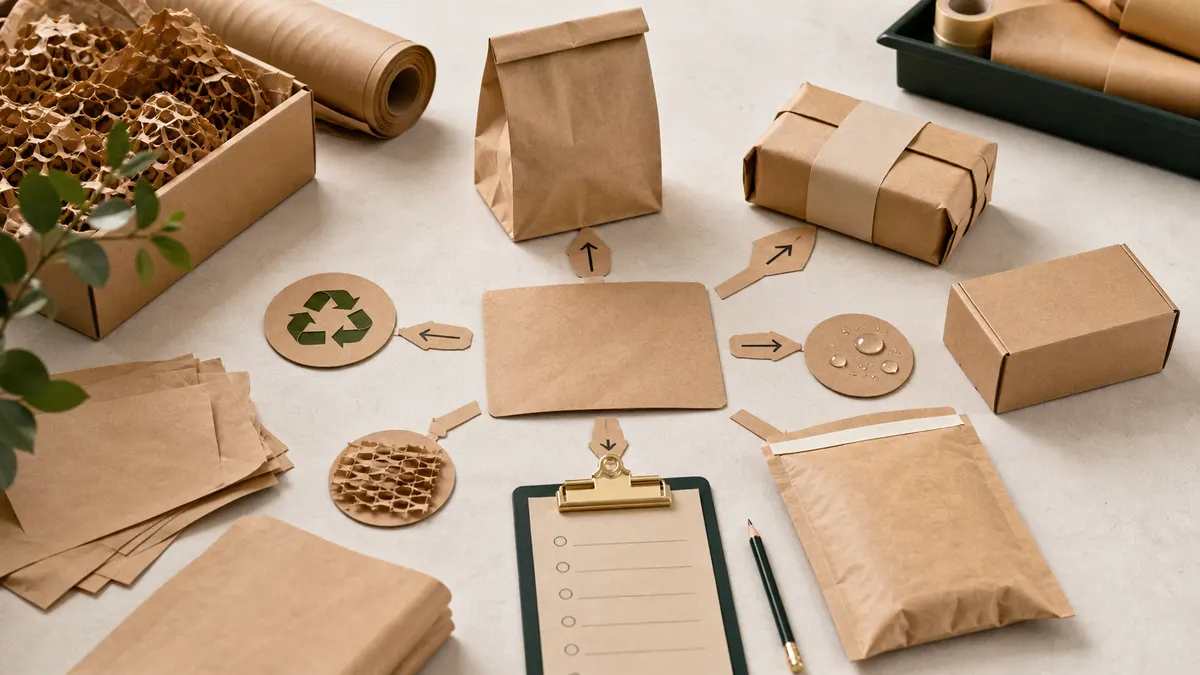
Kraft paper packaging is a strong, familiar paper-based option for many dry goods, takeaway bags, wraps, cartons, sacks, labels, and ecommerce inserts. It can be useful and often lower-impact, but it is not automatically food-safe, greaseproof, waterproof, compostable, recyclable, or eco-friendly.
The practical rule is simple: match the paper grade to the product risk. Dry bakery items, retail bags, dry goods, secondary wraps, and paper sacks are often good fits. Wet, oily, sauced, chilled, frozen, or long-shelf-life products need closer checking because the paper may require a coating, liner, lamination, or a different material.
For Malaysia and the Klang Valley, this matters in everyday settings such as cafe takeaway counters, bakery packing tables, dry goods retail, corporate gifts, ecommerce desks, and foodservice sample rooms. A brown paper bag may look simple, but the real decision sits underneath the surface: fiber, coating, ink, adhesive, food-contact use, logistics, and end-of-life route.
Direct Answer: When Kraft Paper Is a Smart Choice
Kraft paper packaging usually works best when the product is dry, low-grease, short-contact, and not expected to hold liquid. It is also useful as secondary packaging, such as a carry bag, sleeve, void fill, carton insert, or shipping wrap.
It becomes less suitable when the product is wet, oily, acidic, hot for a long time, chilled with condensation, frozen, or shelf-stable because of strict oxygen, aroma, moisture, or light-barrier needs. In those cases, plain kraft paper is usually only one part of a wider packaging structure.
The better buying question is not whether kraft is good. The better question is: good for what product, what contact time, what temperature, what handling route, and what disposal route?
What Is Kraft Paper?
If the starting question is what is kraft paper, the short answer is this: kraft paper is paper or paperboard made from chemical pulp produced by the kraft process. The term describes a material family, not one universal packaging specification.
Kraft grades are common in packaging because they can offer useful tear strength, tensile strength, and durability. Sack kraft grades are designed for heavier-duty uses such as paper sacks and high-load paper bags.
That strength does not answer every performance question. Food safety, grease resistance, moisture resistance, print finish, recycled content, and recyclability still depend on the exact grade and structure.
Kraft Paper Packaging Benefits
The main kraft paper packaging benefits are strength, familiarity, convertibility, and a natural paper appearance. Brown kraft has a practical look that many cafes, bakeries, grocers, and small product brands use because it feels simple and material-led.
Kraft paper can be converted into kraft paper bags, wraps, liners, cartons, sleeves, sacks, labels, paper tapes, corrugated liners, fluting components, and ecommerce inserts. This flexibility is one reason it appears across foodservice, retail, logistics, and industrial packaging.
It can also support lower-impact packaging decisions when it replaces unnecessary plastic, uses responsibly sourced or recycled fiber, and can be recovered in a real local paper recycling route. The important word is “when.” A coated, contaminated, or poorly sorted paper pack may not deliver the environmental result suggested by its appearance.
Common Kraft Paper Packaging Formats
| Format | Common use | Main check |
|---|---|---|
| Kraft paper bags | Retail carry bags, bakery bags, grocery bags, takeaway bags | Load rating, handle strength, food-contact position, humidity exposure |
| Food wraps and liners | Sandwiches, pastries, dry snacks, tray liners | Grease, moisture, heat, direct food contact |
| Cartons and sleeves | Light retail cartons, product sleeves, ecommerce wraps | Stiffness, print quality, abrasion, folding performance |
| Corrugated components | Mailers, shipping boxes, liners, fluting | Compression, stacking, transport distance, storage humidity |
| Paper sacks | Flour, grains, powders, cement, agricultural inputs | Ply count, sack kraft grade, burst strength, filling method |
The same material can behave very differently across these formats. A kraft carry bag, bakery liner, and heavy industrial sack should not be treated as interchangeable.
Best Uses for Kraft Paper Packaging
Kraft paper packaging is usually a good fit for dry food and dry-contact uses: bread bags, pastry bags, dry snack wraps, tea and coffee outer bags, dry grocery items, and takeaway bags for low-moisture items. It also works well for apparel, stationery, books, gifts, cosmetics outer packaging, handmade products, and market bags.
In ecommerce, kraft paper can be used as void fill, wrapping, paper mailers, protective liners, and printed inserts. In industrial settings, kraft appears in sacks, interleaving sheets, pallet liners, and protective wrapping.
For Klang Valley and wider Southeast Asia use cases, realistic examples include bakery counters in Petaling Jaya, cafe takeaway bags in Kuala Lumpur, dry goods retail, small ecommerce packing desks, and foodservice dry-item packs. These are practical environments where paper strength, touch, and simple branding matter, but humidity and handling still need attention.
Kraft Paper Food Packaging: What Must Be Verified
Kraft paper food packaging is not automatically safe for direct food contact just because it is paper. The full structure matters: paper grade, recycled or virgin fiber, inks, coatings, adhesives, and any lamination.
Food packaging material should be selected based on safety, quality, shelf life, and compatibility with the food, including barrier needs for moisture, gases, aroma, grease, and migration risk.1 In Malaysia, buyers should review supplier documentation for the intended food-contact use and check whether the material is suitable for direct or indirect contact.
Direct contact and indirect contact are different questions. An outer carry bag, inner liner, tray liner, wrap, pouch, and printed surface touching food may each need different evidence.
Food risk also changes the answer. Dry bread is different from nasi lemak. A cookie sleeve is different from a fried chicken wrap. A dry tea outer bag is different from a chilled dessert cup with condensation.
Kraft Paper Packaging Limitations
The most common kraft paper packaging limitations are grease, moisture, leakage, heat, color control, and end-of-life uncertainty. Uncoated kraft paper has limited grease and moisture barrier performance, so oily, wet, chilled, or sauced foods usually need a greaseproof grade, coating, liner, or different material.
Risk examples are easy to picture: nasi lemak with sambal oil, fried snacks, sauced rice meals, oily pastries, chilled desserts, frozen goods, wet produce, and soup-adjacent takeaway. Plain kraft may stain, soften, tear, leak, or transfer moisture too quickly.
Possible solutions include greaseproof kraft paper, water-based coating, PE coating, wax coating, an inner liner, a laminated structure, a separate tray, or a different base material. The tradeoff is that coatings and laminates can improve barrier performance while making ordinary paper recycling more difficult.
Paper-based packaging recyclability guidance from CEPI notes that functional coatings, laminates, and treatments can make paper packaging more challenging to recycle, so buyers should verify recyclability through recognized methods or mill feedback where claims matter.2
Brown Kraft Paper vs White Kraft Paper
The brown kraft paper vs white kraft paper decision affects appearance, print result, food display, and brand consistency. Brown kraft gives a natural, rustic, practical look. White kraft is usually better when a clean background, bright food presentation, or clearer color is important.
Brown kraft can make colors appear duller because the brown paper base affects the final color, especially light colors and pastels. This small detail can become a large branding issue.
A practical rule: use brown kraft for black ink, dark green, navy, deep red, white ink, foil, embossing, debossing, line art, and high-contrast minimal graphics. Use white kraft or coated white paperboard when the design depends on full-color photos, pale gradients, skin tones, pastel artwork, or exact color matching.
Recycled Kraft Paper Packaging
Recycled kraft paper packaging can reduce demand for virgin fiber, but recycled content is not a complete environmental answer. Strength, odor, color consistency, cleanliness, and food-contact suitability still need checking.
Virgin kraft is often preferred where strength, consistency, and certain food-contact uses are important. Recycled kraft may be a good fit for secondary packaging, bags, inserts, wraps, and non-food-contact layers, provided the performance is suitable.
A counterintuitive point is worth stating clearly: recycled content does not automatically mean the pack is recyclable, compostable, or lower-impact in every case. A recycled paper pack with heavy coating, food contamination, or limited local recovery may perform poorly at end of life.
Kraft Paper Printing: What Works and What Fails
Kraft paper printing is strongest when the artwork respects the material. Uncoated paper can absorb ink into its fibers, which may reduce color saturation and soften fine image detail compared with coated stocks.
For vibrant full-color artwork, white paperboard or coated white stock often performs better than brown kraft. Brown kraft is usually better suited to black, dark, white-ink, foil, or minimal designs.
Good artwork choices include bold single-color marks, high-contrast text, simple patterns, line illustration, white ink, foil stamping, embossing, and debossing. Risky choices include full-color product photography, pale gradients, small low-contrast text, fine QR codes on rough stock, and exact brand color matching without a real material proof.
One useful print check is barcode and QR readability after folding, rubbing, moisture exposure, and normal handling. A code that scans on a flat digital file may fail on rough brown paper after a humid delivery trip.
Eco Friendly Kraft Packaging Claims Need Care
Eco friendly kraft packaging claims should be specific, qualified, and evidence-based. Kraft can be useful and often lower-impact when it reduces unnecessary plastic, uses responsible fiber, and is recoverable in the local system. It should not be described with broad environmental language unless the claim is true for the actual pack and real disposal route.
The FTC Green Guides advise marketers to avoid broad, unqualified environmental claims and to support claims such as recyclable, compostable, degradable, recycled content, and general environmental benefit with competent evidence.3 That principle is useful beyond the United States because the risk is the same: a good-looking paper pack can still mislead readers if the claim is too broad.
Common claim risks include coated kraft that is not accepted in ordinary paper recycling, food-contaminated paper that cannot be recovered, compostable claims without a realistic composting route, and recycled content claims without a stated percentage.
Safer wording is more precise: “contains X% recycled content,” “made with paper from stated sources,” “recyclable where clean and where suitable paper recycling is available,” or “designed to reduce plastic content compared with the previous pack.” These statements are less dramatic, but they are easier to defend.
When Kraft Paper Is Not the Best Choice
Kraft is not ideal for wet, oily, greasy, sauced, frozen, or high-humidity products without a barrier layer. It is also not ideal for long shelf-life foods that need oxygen, aroma, moisture, or light barriers.
It may be the wrong material where leakage could damage delivery bags, rider equipment, shelves, documents, or customer property. It can also be a poor choice for premium full-color retail packs where exact color control is required.
Other weak-fit cases include tamper evidence, vacuum sealing, retort processing, high puncture resistance, and local end-of-life routes that cannot handle coated or contaminated paper. The material image may be natural, but the product risk should decide the structure.
Alternatives to Consider
| Alternative | Where it may perform better | Main caution |
|---|---|---|
| Coated paperboard | Better print surface and selected barrier needs | Recyclability depends on coating and local recovery |
| Greaseproof paper | Oily bakery and foodservice uses | Food-contact status and recovery route still matter |
| Molded fiber or bagasse | Trays, bowls, clamshells, takeaway bases | Wet strength, oil resistance, and compostability need evidence |
| Mono-material plastic | Wet, frozen, high-barrier, or long-shelf-life products | Recovery depends on resin type and local collection |
| Laminated films | Strong shelf-life and barrier performance | Often harder to recycle |
| Glass or metal | Strong barrier, reuse potential, selected recycling routes | Heavier and often costlier to move |
The best material is not always the one with the best image. It is the one that protects the product with the least practical waste and a credible end-of-life route.
Practical Checklist Before Choosing Kraft Paper
Product fit
- Will the product touch the paper directly?
- Is it dry, oily, wet, acidic, hot, chilled, or frozen?
- How long will the product stay packed?
- Will there be condensation, steam, sauce, or oil migration?
Food-contact suitability
- Is the paper grade suitable for the intended direct or indirect food-contact use?
- Are inks, coatings, adhesives, and laminations suitable for the contact position?
- Is supplier documentation available for the intended food use?
- Is recycled fiber used only where appropriate for the food-contact structure?
Barrier performance
- Is the paper plain, grease-resistant, moisture-resistant, heat-tolerant, or leak-resistant?
- What coating, liner, or lamination is used?
- Does the coating affect paper recycling or composting claims?
- Has the structure been tested with the real food temperature and contact time?
Strength and logistics
- What are the GSM, basis weight, ply count, burst strength, and load rating?
- Will it survive stacking, rider delivery, humid storage, and customer handling?
- Does the bag handle or seal method match the packed weight?
- Will the paper scuff, tear, or soften in normal Klang Valley humidity?
Print and information
- Is the stock brown, white, coated, or uncoated?
- Will brand colors shift on brown kraft?
- Are QR codes, barcodes, expiry dates, ingredient notes, and small text readable?
- Will ink rub, smudge, or lose contrast after handling?
Environmental wording
- What exact environmental claim will appear on the pack or article?
- Is there evidence for recycled content, recyclability, compostability, or certification?
- Is the claim true in Malaysia, or only in another market?
- Will food contamination or coating make recycling unlikely?
Comparison Table: Fit by Use Case
| Use case | Typical fit | Reason |
|---|---|---|
| Dry bakery bag | Good | Works well if food-contact paper is verified and grease exposure is low. |
| Fried food wrap | Conditional | Needs greaseproof grade, coating, or liner. |
| Sauced takeaway meal | Usually weak | Leakage and oil migration risk are high unless paired with a suitable tray or barrier structure. |
| Ecommerce wrap | Good | Useful as secondary packaging, void fill, or protective wrap. |
| Frozen food pouch | Usually poor | Needs high moisture and temperature performance, often beyond plain kraft. |
| Premium full-color retail box | Conditional | White or coated paperboard may give better color control. |
| Heavy powder sack | Good | Proper sack kraft grades are designed for strength and durability. |
| Wet produce | Conditional | Humidity, wet strength, and ventilation requirements must be checked. |
A Practical Workflow for Malaysian SMEs
- Define the product risk: dry, oily, wet, hot, chilled, frozen, fragile, aromatic, or long shelf-life.
- Choose the format: bag, wrap, liner, carton, sack, label, tape, mailer, or corrugated component.
- List the technical data needed: GSM, grade, coating, food-contact status, recycled content, print method, and barrier claim.
- Run real-use trials in local handling conditions: packing, shelf display, humid storage, rider delivery, and customer handling.
- Review environmental wording before printing, especially claims about recycling, composting, biodegradation, plastic reduction, or recycled content.
- Approve the structure only after the product, print, handling, and end-of-life assumptions have been checked together.
This workflow is intentionally plain. Most packaging failures happen when food risk, humidity, print, coating, and disposal assumptions are reviewed separately instead of together.
FAQ
Is kraft paper always recyclable?
No. Plain, clean paper may be recyclable where suitable collection and paper recycling exist. Coatings, laminates, adhesives, and food contamination can change the answer.
Is kraft paper compostable?
Not automatically. Compostability depends on the full structure, including coatings, inks, adhesives, and the availability of a realistic composting route.
Is kraft paper safe for food?
Not automatically. The grade, fiber source, ink, coating, adhesive, and contact position must match the intended food use.
Can brown kraft paper show full-color artwork well?
It can print, but colors often look duller than on white stock. Brown kraft is usually stronger for dark ink, white ink, foil, and simple high-contrast designs.
What is a quick test for kraft paper packaging?
Pack the real product, expose it to normal heat, moisture, oil, stacking, transport, and handling, then check staining, tearing, leaking, print rub, scanning, odor, and customer-facing appearance.
Neutral Next Step
Before choosing a kraft structure, compare the exact paper grade, coating, ink, adhesive, food-contact position, and recovery claim against the real product conditions. Then review a broader packaging materials guide to see whether paperboard, molded fiber, mono-material plastic, film, foil, glass, or metal would protect the product more reliably.